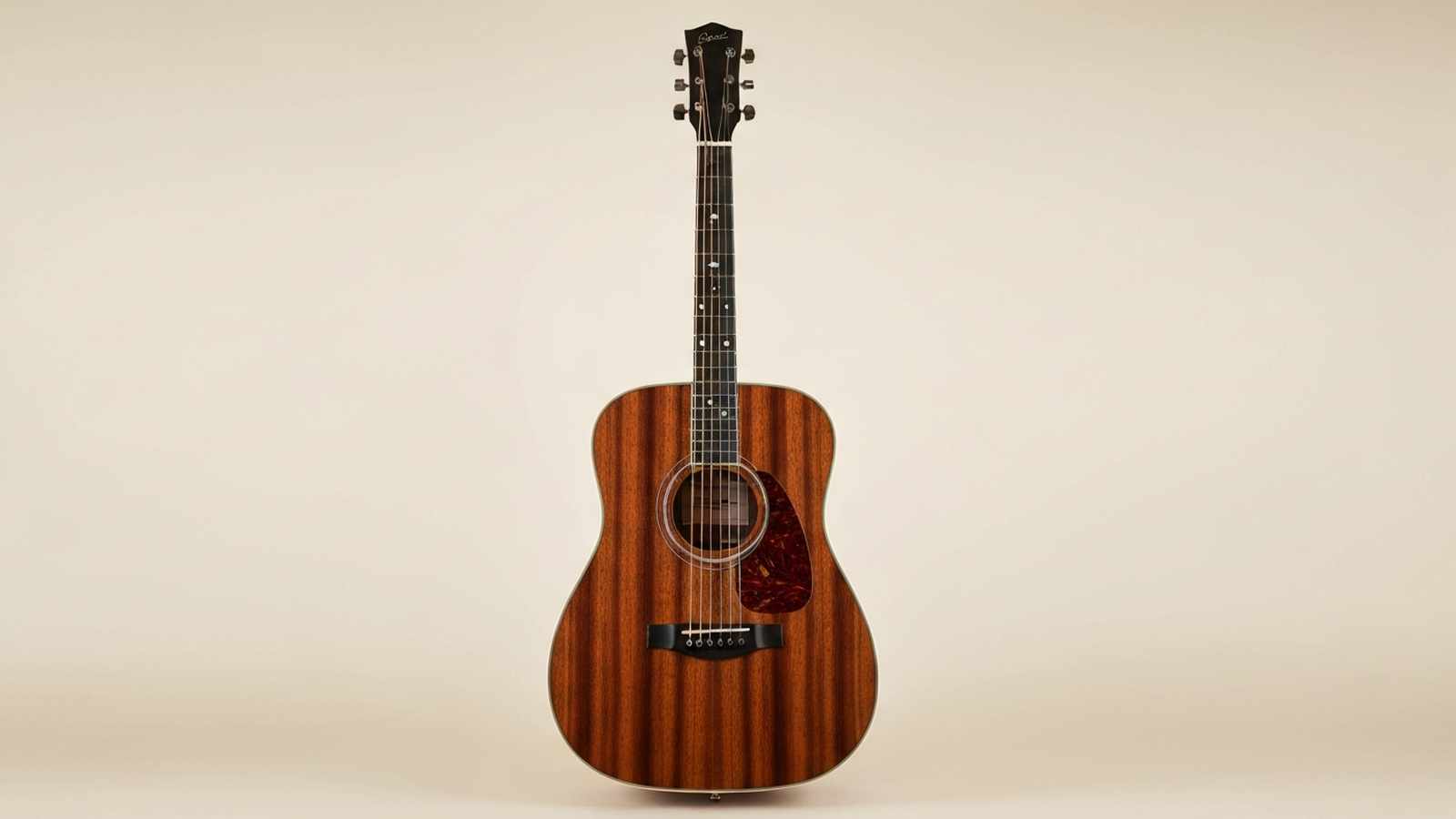
Yamaha FG850
Affiliate link. No extra cost to you
An All-Mahogany Yamaha That Finds Its Own Lane
After working through hundreds of owner reports, demo recordings, and the spec sheet, the Yamaha FG850 stands out as an all-mahogany FG that carves out its own identity in a lineup dominated by spruce-topped strummers. At 399 dollars street, it uses a solid mahogany top (not Sitka spruce) paired with laminate mahogany back and sides, producing a drier, punchier tone that suits blues, country blues, and percussive fingerstyle better than the FG800 or FG830. Owners consistently call the dark cherry burst finish genuinely premium-looking, and they repeatedly report a factory setup that is playable straight out of the gig bag.
At a Glance: Specifications
| Body Shape | Traditional Western (FG Dreadnought) |
| Top | Solid Mahogany |
| Back & Sides | Mahogany (laminate) |
| Neck | Nato, C-profile |
| Fingerboard | Rosewood |
| Scale Length | 25.6" |
| Nut Width | 1.6875" |
| Electronics | None (acoustic only) |
| Origin | Indonesia |
| Street Price | $399 |
First Look: Design and Build
The FG850 ships in a Yamaha-branded gig bag. At 4.5 pounds on the spec sheet it is a touch heavier than the FG830, which I attribute to the denser laminate mahogany back and sides. The dark cherry burst finish is applied evenly across the top and shows the solid mahogany grain through the stain in a way that, in owner photos, looks surprisingly close to a vintage Gibson J-45 in color and vibe.
Fit and finish complaints are rare in owner reviews: buffing haze, rough fret ends, and glue squeeze-out at the binding junction almost never come up. Indonesian-built Yamahas have consistently improved in factory quality over the last five years, and the FG850 reflects the current state of that production line.
Tone and Sound Character
All-mahogany dreadnoughts have a distinct personality that many players fall in love with after years of rotating between spruce-topped guitars. The solid mahogany top produces a drier, faster-decaying tone with more upper-midrange punch than a spruce top. In demo recordings of percussive fingerstyle arrangements like "The Thrill Is Gone" or Delta blues slide playing, the FG850 grabs individual notes and makes them pop out of the mix in a way the FG830's rosewood back cannot match.
Strummed chord work is where the mahogany top trades off against spruce. The bass bloom is less pronounced than the FG830 and the top-end sparkle is more muted than the FG800. In recorded comparisons, G-D-Em-C strummed through a capo at the 3rd fret stays focused and tight on the FG850 where the rosewood-backed FG830 spreads out. Which you prefer depends entirely on what you play.
Playability and Setup Out of the Box
Owner measurements put factory action around 2.4mm at the 12th fret on the low E and 1.9mm on the high E, essentially identical to the FG830 and consistent with Yamaha's Indonesian factory targets. Out of the gig bag this action is playable for both strumming and moderate fingerpicking, though serious fingerstyle players will want a 30 dollar tech setup to bring both measurements down by roughly 0.3mm.
The 1.6875 inch nut width is standard FG geometry and feels comfortable for most adult hands. The nato neck with C-profile carve is less substantial than a traditional D-shape but plenty thick under the palm for long sessions. Long-term owners on guitar forums report no fretting-hand fatigue even after extended practice sessions.
Build Quality and Materials
Owner photos consistently show uniform grain orientation on the solid mahogany top and even finish penetration under the dark cherry burst. Inside the soundhole, the bracing pattern is Yamaha's scalloped X-bracing, the same bracing used on every FG series guitar and the primary reason these instruments sound better than comparable dreadnoughts from other brands at similar price points.
Laminate mahogany back and sides are visible through the soundhole as multi-ply construction. The laminate is stable and largely invisible tonally compared to solid mahogany, but you do give up some of the tonal maturation that solid wood would provide over 5-10 years of playing. For the 399 dollar price, laminate back and sides are an acceptable trade-off.
Who Should Buy the Yamaha FG850
The FG850 is aimed at intermediate players who want an all-mahogany dreadnought voice at a price well below solid-back mahogany alternatives like the Martin D-15M. Blues players, country pickers, solo fingerstyle players, and anyone looking for a tonal contrast to an existing spruce-topped guitar in their collection all land here appropriately. The dark cherry burst is also one of the more attractive finish options at this price point.
Skip the FG850 if you are primarily a strummer (the FG830 will give you more bloom), if you need maximum projection for loud acoustic ensembles (spruce tops are louder), or if you plan to collect tonewoods rather than play them (the laminate back puts a ceiling on long-term tonal growth). The FG850 is a specialized voice, not a one-size-fits-all dreadnought.
What We Loved
- Solid mahogany top at a 399 dollar price point
- Dark cherry burst finish that owners consistently call premium-looking
- Dry, articulate tone suits blues and fingerstyle playing
- Owners consistently report a playable factory setup out of the gig bag
What to Watch
- Less bass bloom than spruce-topped FG alternatives
- Laminate back and sides limit long-term tonal maturation
- No hardshell case at the 399 dollar price
Frequently Asked Questions

Shmulik Dorinbaum
Working Musician · 20+ Years Songwriting & Performing · Hebrew Recording Artist
A 44-year-old working musician and father of two from Israel, writing and recording for over twenty years across country, folk and rock. Strum Avenue is where two decades of buying, breaking, setting up and arguing about acoustic guitars gets written down.
Raised on Chris Cornell, Brandon Boyd (Incubus), Eddie Vedder.