How to Choose the Best Acoustic Guitar for Fingerstyle
What Fingerstyle Actually Demands From a Guitar
Fingerstyle acoustic playing demands a specific combination of specs that strum-focused dreadnoughts don't deliver: a nut width of at least 1.75 inches (1.8 is even better), a smaller body shape like 000 or OM for string separation, a solid top that responds to a light touch, and an action set lower than typical strum guitars, around 1.9 mm on the high E at the 12th fret. Players who try to learn Tommy Emmanuel material on a factory dreadnought with 1.69" nut spacing struggle for a year before realizing the guitar is fighting them. I have seen this happen dozens of times at the Strum Avenue bench.
This guide explains the four specifications that matter most for fingerstyle, with reference instruments at every price tier. I'll name the specific models worth considering under $500, under $1,500, and at the $2,500+ level, and I'll flag the specs you should refuse to compromise on regardless of budget.
Body Shape: Why OM and 000 Rule Fingerstyle
The OM (Orchestra Model) and 000 body shapes are the fingerstyle standards for a reason. Both have a shorter body depth and slightly narrower waist than a dreadnought, which produces a more balanced tonal spectrum, the bass is tight instead of booming, the mids are clear, and the highs have room to breathe. Martin's OM-28, Taylor's 812ce, and Collings' OM1A are all variations on this formula. The dreadnought's deeper bass overwhelms fingerstyle's quiet dynamics; the OM lets each note sit in its own space.
Concert-sized guitars (Taylor GA, Martin 00) are a step smaller and work well for players with smaller hands or a quieter style. Grand auditorium shapes (Taylor 814ce) split the difference between OM and dreadnought, a good compromise if you want one guitar that handles both strumming and fingerpicking. I recommend OM or 000 as a first choice and grand auditorium as a second choice for anyone serious about fingerstyle.
Nut Width: The Spec That Separates Fingerstyle Guitars
Nut width is measured in inches across the top of the nut. Standard dreadnoughts ship with 1.69" or 1.6875" nut widths, which give the thumb room to wrap around for bass notes but crowd the fingers when picking. Fingerstyle guitars typically use 1.75" (the Martin OM standard) or 1.8" (the Collings and some Taylor models). The extra 0.11 inches sounds trivial but translates into about 2 mm more spacing between each string, enough to dramatically improve clean finger independence.
Some players prefer even wider, 1.875" or 2", for classical-influenced fingerstyle. Pierre Bensusan's signature Lowden guitars use an approximately 1.8" spacing. Andy McKee's custom Greenfield G4 uses 1.75". If you are not sure which feels right, play a Martin OM-28 (1.75") and a Collings OM1A (1.8") side by side at a well-stocked shop. The difference is immediately obvious after 30 seconds.
Tonewoods: What Actually Matters for Fingerpicking
For fingerstyle, the top wood matters more than the back and sides. Cedar tops (common on Larrivée and Lowden) respond to a lighter touch than Sitka spruce, a cedar-topped guitar will bloom under fingerstyle dynamics where a Sitka top can feel stiff. Sitka is more versatile across strum and fingerstyle but requires more attack to wake up. Engelmann spruce is the softest of the commonly-used tops and is a fingerstyle favorite when available, though it typically adds $200-500 to the price.
Back and sides matter less for pure fingerstyle than for bluegrass flatpicking. Indian rosewood adds bass and overtones, mahogany adds midrange punch and clarity, maple adds brightness and articulation. For fingerstyle, I generally prefer rosewood for its overtone complexity, the sympathetic ringing of rosewood makes chord-melody arrangements sound larger. Mahogany is a good second choice for players who prefer a drier, more articulate tone.
Action and Setup: Non-Negotiable for Fingerstyle
Factory action on most acoustics is too high for fingerstyle. A fingerstyle-optimized setup measures 1.8-2.0 mm on the low E at the 12th fret and 1.4-1.6 mm on the high E. This is 0.4-0.6 mm lower than a typical strum setup. If your new guitar ships with higher action (most do), budget $60-80 for a proper setup before you even start practicing seriously. I cannot overstate how much this matters for learning fingerstyle technique.
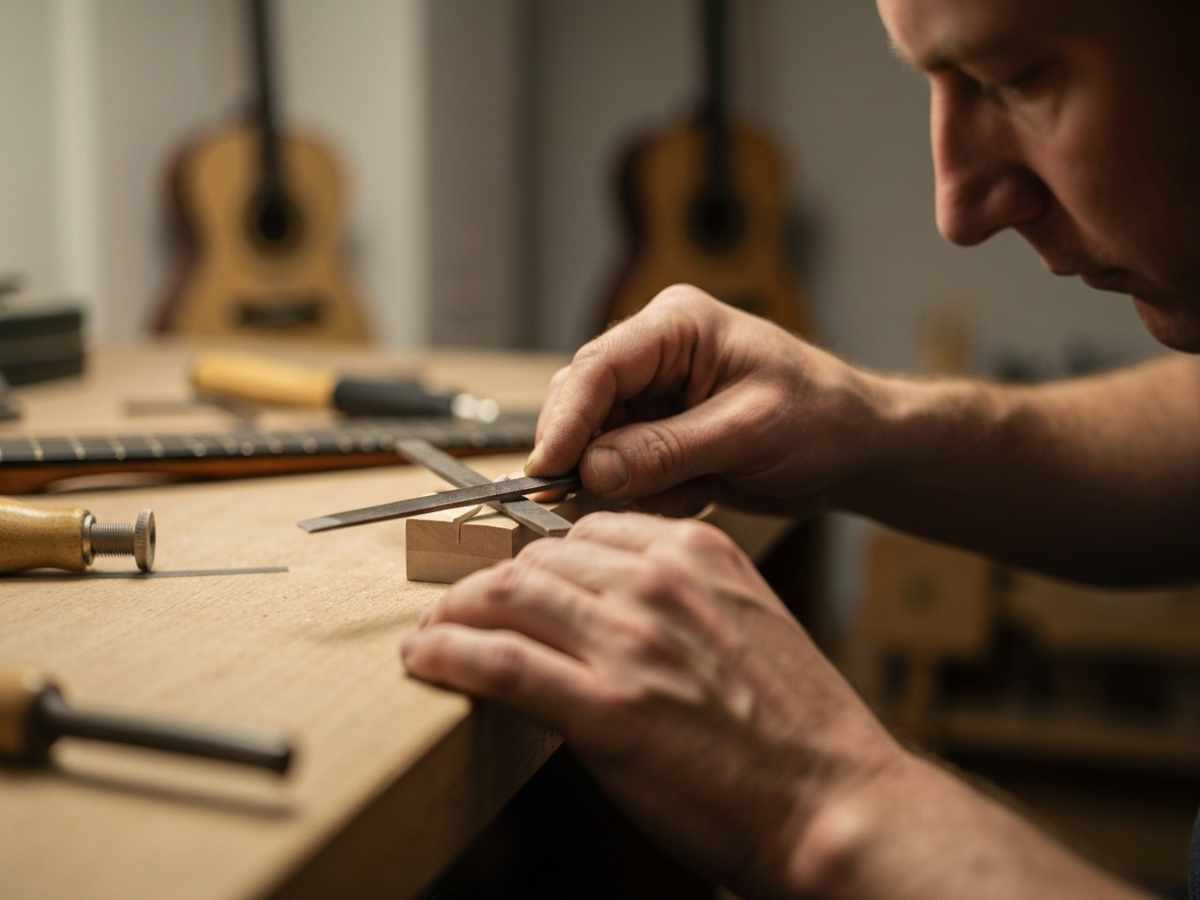
A good setup should also include nut slot depth optimization. Factory nuts are almost always slightly high on the first fret, which forces extra fretting pressure and creates intonation problems for open chord fingerstyle. A tech can file the nut slots down in 0.1 mm increments to produce an action of about 0.5 mm at the first fret, the fingerstyle standard.
Specific Models by Budget Tier
Under $500: Seagull S6 Original ($439) or Yamaha FS830 ($329). Both have solid tops, narrow concert-sized bodies suitable for fingerstyle, and reach the 1.72" nut width on most variants. They will not compete with $2,000 guitars but are honest starter instruments.
$500-$1,500: Martin 000-10E ($999) or Taylor GS Mini Mahogany ($599) for travel players. At this tier the Martin is my go-to recommendation, it hits the correct 1.75" nut, uses solid sapele, and has the right OM body shape for fingerstyle. The Taylor 114ce is a good grand auditorium alternative for players who want electronics.
$1,500-$3,000: Martin OM-28 ($2,899) or Taylor 812ce ($3,199). The OM-28 is the definitive mid-tier fingerstyle dreadnought and the single guitar I would recommend to any intermediate fingerstyle player without hesitation. The Taylor 812ce is the more modern alternative with a brighter top end.
$3,000+: Collings OM1A or OM2H ($4,500-6,000), Lowden O-35 ($7,000+), or Goodall Concert Jumbo. At this tier you are buying handmade instruments with tone wood selection and build quality that mass-production cannot match. Most serious fingerstyle professionals end up with a small-shop instrument from one of these builders.
Frequently Asked Questions

Shmulik Dorinbaum
Working Musician · 20+ Years Songwriting & Performing · Hebrew Recording Artist
A 44-year-old working musician and father of two from Israel, writing and recording for over twenty years across country, folk and rock. Strum Avenue is where two decades of buying, breaking, setting up and arguing about acoustic guitars gets written down.
Raised on Chris Cornell, Brandon Boyd (Incubus), Eddie Vedder.