Acoustic Guitar Intonation: How to Adjust It (Setup Guide)
What Intonation Is and Why It Goes Out
Intonation is the alignment between the open-string pitch and the fretted pitches along that string. A properly intonated guitar plays in tune with itself at every fret, which means the 12th-fret harmonic and the 12th-fret fretted note share the same pitch within 2-3 cents. When the 12th fret reads 5-10 cents sharp or flat on a tuner, the instrument is out of intonation and chords above the 5th fret will sound wrong to any trained ear.
I adjust intonation on 30-40 acoustics a year at the Strum Avenue bench. The common causes are a worn saddle, a nut cut too high, wrong string gauge, excessive fretboard wear, or a neck that needs a truss rod adjustment. Unlike an electric guitar, an acoustic guitar does not have individually adjustable saddles, so the job requires shaping the one-piece bone or Tusq saddle to set the compensation correctly.
Tools You Need Before You Start
Five tools cover the job: a Peterson StroboStomp Mini tuner ($119) or the StroboClip HDC clip-on ($89) for precise cent readings, a 6-inch stainless ruler with .5mm markings, a set of automotive feeler gauges ($8), a flat mill file or fine sandpaper (320-600 grit), and a small flat-head screwdriver for reference measurements. If you want to buy a replacement saddle for practice, Graph Tech Tusq blanks are $8-12.
Do not use a standard Boss TU-3 or a smartphone tuner for this job. Both read to the nearest cent at best and often lag on the decay portion of the note, which is exactly when you need a stable reading. A strobe tuner locks visually on the pitch and lets you see a 1-cent error the moment you pluck the string.
Diagnosing the Problem
Tune all six strings carefully to standard pitch with a strobe tuner. Now play the 12th fret harmonic on the low E string (hit it lightly with the fretting hand just touching the string directly above the 12th fret wire). Read that pitch. Then fret the 12th fret normally and pick it with a consistent medium attack. Read that pitch too. Compare the two readings.
If the fretted note is sharper than the harmonic, the saddle contact point is too close to the nut and you need to move it away from the nut. If the fretted note is flatter than the harmonic, the saddle contact point is too far from the nut and you need to move it toward the nut. Repeat this for all six strings and write the numbers down before doing any work.
Shaping a Fixed Acoustic Saddle
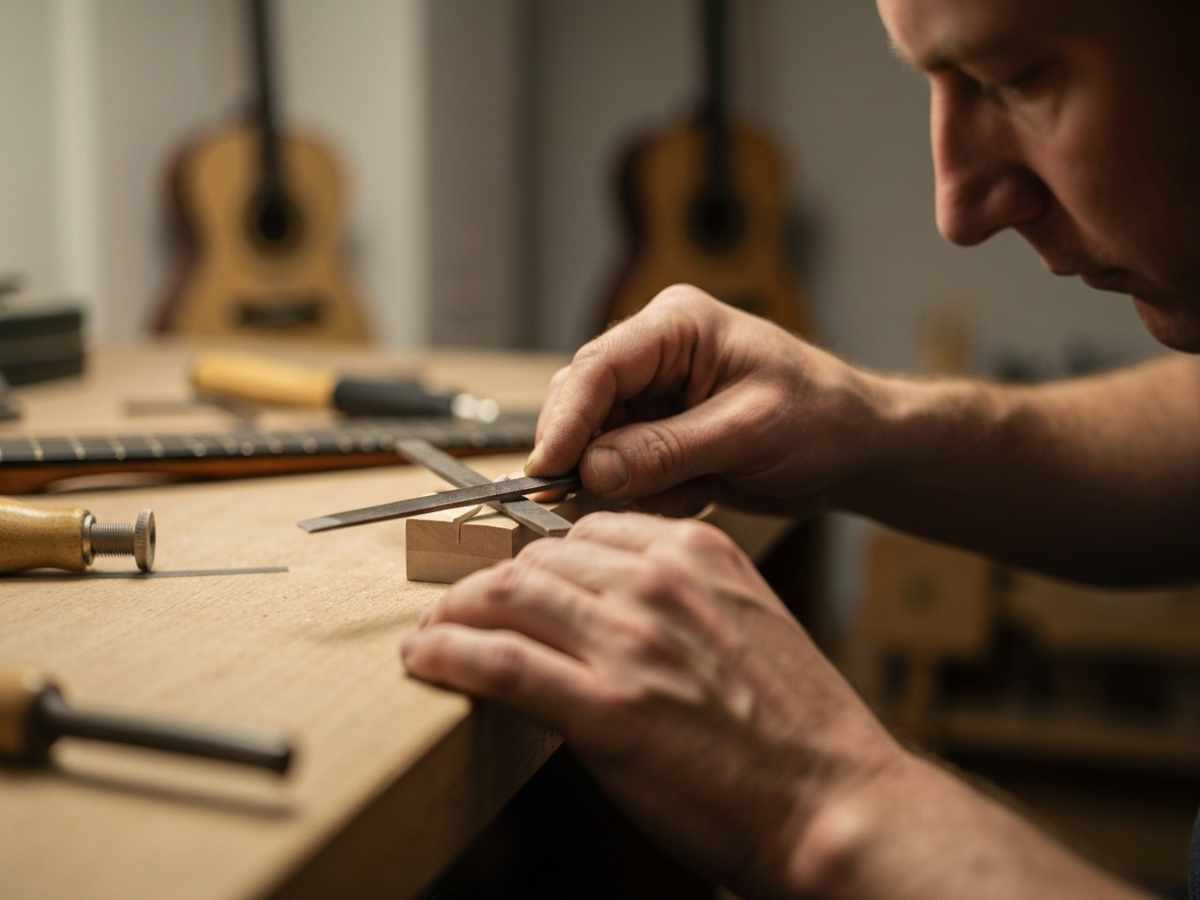
On a standard acoustic, the saddle sits in a slot that is usually 2.5-3mm wide, and the string contacts the top edge of the saddle. You can move that contact point forward or backward by shaping the top of the saddle with a small file. A sharp crest near the back edge moves the contact point closer to the nut (string becomes flatter). A sharp crest near the front edge moves the contact point away from the nut (string becomes sharper).
Work in small increments. Remove the saddle, file or sand no more than 0.5mm of material at a time, reinstall it, tune up, and retest. A single full pass takes 5-10 minutes. Most saddles need 2-4 passes before all six strings land within 2 cents of correct. If you are new to saddle work, practice on a Tusq blank before touching an original bone saddle.
Why the Nut Also Affects Intonation
A nut cut too high forces the player to press the string further down to reach the fret, which stretches the string above its true pitch. This makes the lower frets (1-4) play sharp relative to the rest of the neck. The result is identical to an intonation error even though the saddle is correctly positioned.
Check nut height by placing a capo on the 3rd fret and measuring the gap between the bottom of each string and the top of the 1st fret with a feeler gauge. The correct gap is 0.005"-0.010" (0.13-0.25mm) for most steel-string acoustics. If any string sits higher than 0.015", lower the nut slot with a nut file before adjusting the saddle. Otherwise you will chase intonation errors that are actually nut problems.
Known Issues and When to Stop
Wound string compensation is not linear. The G string in a standard light-gauge set (.024 wound) often needs significantly more compensation than the D or A strings because of its relatively large mass-to-tension ratio. This is why many modern acoustic saddles are cut with a pronounced front-to-back bias on the G string position.
Stop adjusting when all six strings land within 2-3 cents of correct. Chasing 0-cent precision wastes time because string temperature, humidity, and your pick attack each contribute 1-2 cents of variation. If you cannot get closer than 5-6 cents on a single string after three passes, suspect a worn fret or a twisted neck, both of which are bench repair jobs rather than saddle tweaks.
Frequently Asked Questions

Shmulik Dorinbaum
Working Musician · 20+ Years Songwriting & Performing · Hebrew Recording Artist
A 44-year-old working musician and father of two from Israel, writing and recording for over twenty years across country, folk and rock. Strum Avenue is where two decades of buying, breaking, setting up and arguing about acoustic guitars gets written down.
Raised on Chris Cornell, Brandon Boyd (Incubus), Eddie Vedder.