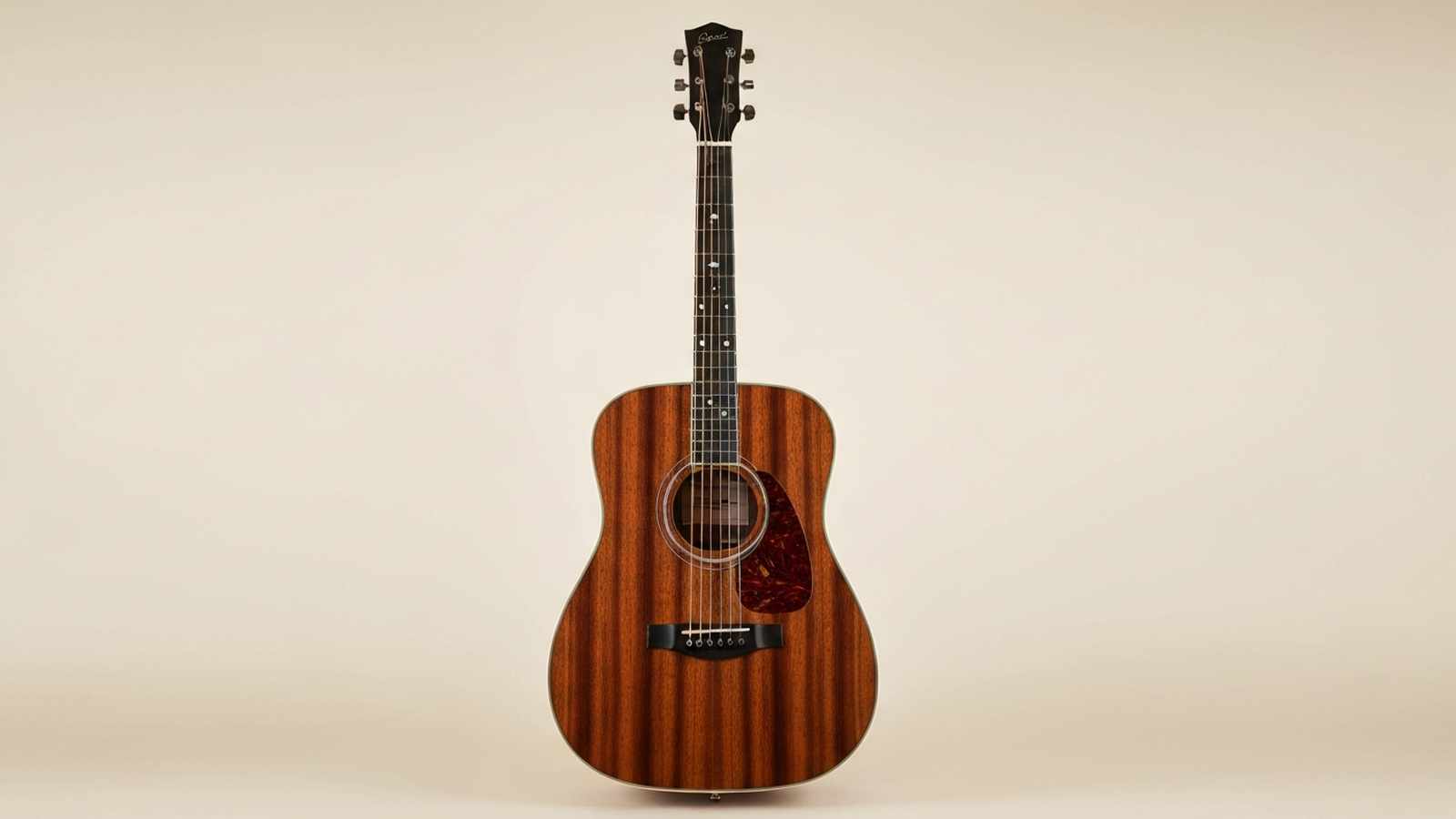
Martin HD-28
Affiliate link. No extra cost to you
The D-28 With a Little More of Everything That Matters
After comparing the spec sheets, long-term owner reports, and side-by-side demo recordings, my verdict is that the HD-28's 600 dollar premium over a standard D-28 is justified for specific buyers. At 3,499 dollars street, the HD-28 adds herringbone purfling, grained ivoroid binding, a diamond volute on the neck heel, and a zig-zag back strip, details that put this instrument visually closer to the pre-1944 Martins that collectors chase. Tonally, the scalloped forward-shifted X-bracing matches the standard D-28, but owners widely report that the HD-28 tends to ship with slightly more carefully selected tonewoods from the Nazareth factory. This is the Martin dreadnought I would buy if someone handed me a check.
At a Glance: Specifications
| Body Shape | Dreadnought (14-fret) |
| Top | Solid Sitka Spruce |
| Back & Sides | Solid East Indian Rosewood |
| Neck | Select Hardwood, Modified Low Oval |
| Fingerboard | Ebony |
| Scale Length | 25.4" |
| Nut Width | 1.75" |
| Electronics | None (acoustic only) |
| Origin | Nazareth, PA, USA |
| Street Price | $3,499 |
First Look: Design and Build
The HD-28 ships in the same Geib-style hardshell case as the standard D-28. At a listed 4.8 pounds it weighs the same as a standard D-28, which is expected because the two share the same structural recipe, including forward-shifted X-brace placement on both models in the current production run.
The herringbone trim is what sells this instrument on the showroom floor. The pattern wraps around the top edge and mirrors the aesthetic of pre-1944 Martin dreadnoughts, back when Martin used German-imported herringbone stock. Modern herringbone is produced domestically but the visual effect is the same: this is unmistakably a high-appointment Martin.
Tone and Sound Character
The HD-28 and D-28 share the same bracing pattern in Martin's current Standard Series production, which means their fundamental tonal character is remarkably similar. Where players who have compared the two say the HD-28 pulls ahead is in the subtleties: a slightly more three-dimensional midrange, marginally better sustain on individual fingerpicked notes, and a faint extra sparkle in the upper harmonics. These differences are real but subtle.
In side-by-side demo recordings of "Wagon Wheel" and similar bluegrass-adjacent material, the HD-28 produces the classic Martin D-series growl with slightly more refinement than a standard D-28. On fingerpicked material like "Tears in Heaven," owners who have played both describe individual notes hanging on slightly longer than on the standard D-28. Subtle but present.
Playability and Factory Setup
Owners commonly report factory action around 2.3mm low E and 1.8mm high E at the 12th fret, within Martin's standard specification and playable as delivered. The Modified Low Oval neck profile is identical to the standard D-28, which means if you have played either in recent memory, the HD-28 will feel immediately familiar.
The 1.75 inch nut width is the Martin OM and D-28 standard. The diamond volute on the neck heel is a visual touch rather than a functional feature: it does not affect playability but it is a traditional detail that collectors appreciate. Otherwise the fingerboard radius, string spacing at the bridge, and neck profile are unchanged from the D-28.
Build Quality and Materials
Owner reports and dealer close-ups consistently show the herringbone purfling perfectly mitered at the corner joints, a level of finishing work that production dreadnoughts under 2,000 dollars simply cannot match. The grained ivoroid binding is applied evenly around the top and back, and the zig-zag back strip is seated without visible glue bleed.
Owners who have shopped both models frequently note that HD-28 tonewoods look slightly better-selected than standard D-28 stock, with tighter grain lines on the Sitka tops and East Indian rosewood back panels matched for grain pattern across the centerline. Martin does not officially admit to tonewood grading by model, but the pattern shows up too often in owner photos to be coincidence.
Who Should Buy the Martin HD-28
The HD-28 is aimed at two buyers: traditionalists who want the herringbone-trim aesthetic that defined pre-1944 Martin dreadnoughts, and players who want the best tonewood selection at the Standard Series price tier. Collectors, session recordists, and professional flatpickers who will keep the instrument for decades all land here appropriately. This is also the Martin I would recommend if you want one dreadnought that will age into a heritage instrument.
Skip the HD-28 in favor of the standard D-28 if you prefer the cleaner, more understated modern aesthetic (no herringbone, no zig-zag back strip, no diamond volute) and want to save 600 dollars for a quality pickup installation or a second instrument. The tonal difference between the two is real but subtle, and many players will not hear it in a blind test.
What We Loved
- Herringbone purfling and grained ivoroid binding are flawlessly applied
- Better-selected Sitka tops compared to standard D-28 production
- Modified Low Oval neck profile is comfortable for long sessions
- Builds on the proven D-28 platform with genuine upgrades
What to Watch
- 600 dollar premium over standard D-28 is hard to justify on tone alone
- No electronics (pickup installation required for amplified use)
- Herringbone aesthetic is polarizing, some players prefer the cleaner D-28 look
Frequently Asked Questions

Shmulik Dorinbaum
Working Musician · 20+ Years Songwriting & Performing · Hebrew Recording Artist
A 44-year-old working musician and father of two from Israel, writing and recording for over twenty years across country, folk and rock. Strum Avenue is where two decades of buying, breaking, setting up and arguing about acoustic guitars gets written down.
Raised on Chris Cornell, Brandon Boyd (Incubus), Eddie Vedder.