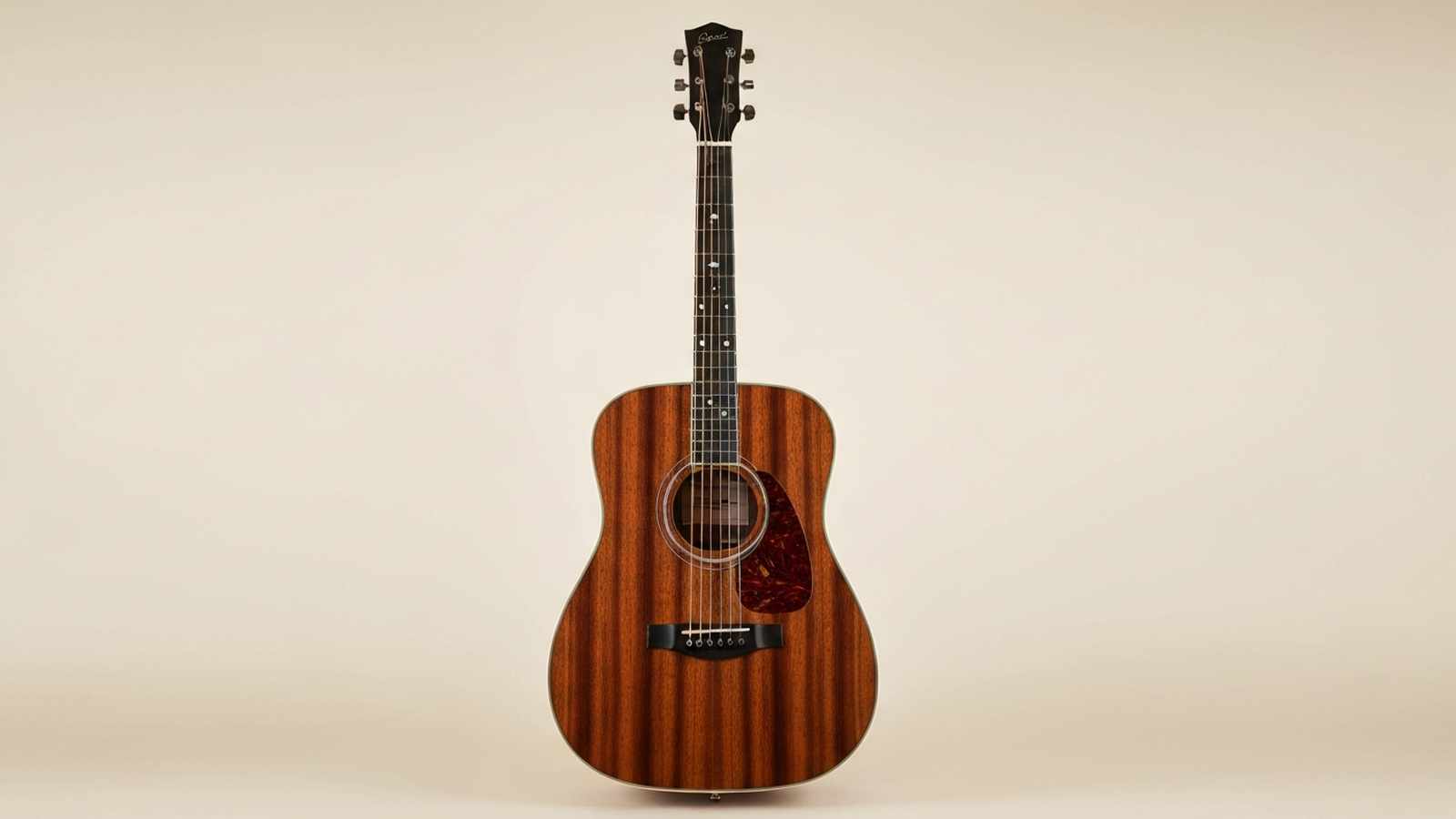
Epiphone DR-100
Affiliate link. No extra cost to you
The DR-100 Earns Its Place, But Yamaha Still Wins the Segment
After working through the DR-100's spec sheet, demo recordings, and hundreds of owner reviews, I respect what it offers but cannot place it ahead of the Yamaha FG800 in the beginner dreadnought conversation. At $159 street, the DR-100 ships with a laminate spruce top and a proper Gibson-family headstock that appeals to players who will eventually want a Gibson J-45. Tonally it is comparable to the Yamaha F325D, with a slightly darker voice and similar factory tolerances. For a Gibson-curious beginner it is the right pick; for pure value, Yamaha still wins this segment.
At a Glance: Specifications
| Body Shape | Square-Shouldered Dreadnought |
| Top | Laminate Spruce |
| Back & Sides | Laminate Mahogany |
| Neck | Mahogany |
| Fingerboard | Indian Laurel |
| Scale Length | 25.5" |
| Nut Width | 1.68" |
| Electronics | None |
| Origin | Indonesia |
| Street Price | $159 |
First Look: Design and Build
Epiphone ships the DR-100 in a standard cardboard box with no gig bag. In the Natural finish the guitar comes in at a listed 4.4 pounds, slightly heavier than the Yamaha F325D by 0.2 pounds, which translates to a marginally bassier voice when strummed. The square-shouldered dreadnought shape gives the DR-100 a visual closer to a Gibson J-200 than a Martin D-28, which is part of the Epiphone branding appeal.
The slope-shouldered Gibson headstock is the main visual distinction. It is purely cosmetic at this price level, but for a beginner who dreams of eventually owning a Gibson J-45, the Epiphone silhouette carries meaningful emotional weight.
Tone and Sound Character
Laminate construction puts a hard ceiling on the DR-100's tonal potential. In demo recordings, strummed cowboy chords produce adequate volume and a slightly darker, warmer voice than the Yamaha F325D: the laminate mahogany back and sides contribute a modest midrange warmth that is a small but real advantage for rhythm playing. At practice-room volume the DR-100 sounds pleasant and balanced.
Fingerpicked passages are limited, as with all laminate-topped guitars. In fingerstyle demos, even a simple arrangement of "Hallelujah" stays polite rather than expressive. For beginner fingerpicking this is fine; by the 12-month mark a student will start craving the dynamic range of a solid-top instrument.
Playability and Setup
Owner reports put typical factory action around 2.8mm at the 12th fret low E and 2.1mm on the high E, within acceptable range for a beginner but slightly tall for comfortable fingerpicking. A $30 setup at a qualified tech will bring action down to more comfortable levels and address the inconsistent nut slot depths that owners frequently mention.
The 1.68-inch nut width is the narrowest in this category, and the 25.5-inch Gibson scale length is slightly longer than the Yamaha FG800's 25-inch scale. The difference is minor but noticeable: string tension at standard pitch is roughly 4% higher on the Epiphone, which can make the first weeks of fretting slightly more effortful.
Build Quality at the Epiphone Indonesian Factory
Epiphone's Indonesian factory has improved noticeably since Gibson's 2018-2020 restructuring. Recent owner reviews describe clean binding, correctly glued bracing, and no sharp fret ends. The finish is thin polyurethane that is durable enough for beginner use, though not as elegant as a satin nitro finish.
Where the DR-100 falls short of the Yamaha FG800 is in factory consistency. Owner reviews over the years surface a steady trickle of factory defects: occasional loose frets, high action, and the rare bridge glue problem. Quality control has tightened considerably since 2021 but still lags behind Yamaha's tight Indonesian production.
Who Should Buy the Epiphone DR-100
Buy the DR-100 if you are a beginner who specifically wants the Gibson family aesthetic and your budget is under $175. The slope-shouldered body, Gibson-style headstock, and Epiphone badge make the DR-100 the natural entry point for players who eventually plan to own a Gibson J-45 or Hummingbird. It is a respectable first guitar in the Gibson lineage.
Skip the DR-100 if you are a pure value shopper: the Yamaha FG800 at $229 offers a solid Sitka spruce top that is meaningfully better tonally, with tighter Yamaha factory tolerances. If you can only spend $159, the Yamaha F325D is a near-even alternative with slightly better build quality. The DR-100 is a style purchase more than a pure performance one.
What We Loved
- Gibson-family headstock and body shape
- Darker, warmer voice than laminate spruce competitors
- Build quality acceptable for the $159 price
- Square-shouldered dreadnought produces real bass response
What to Watch
- Laminate top will not bloom with playing time
- Factory consistency slightly below Yamaha F325D
- Tall factory action typically needs a setup
- No gig bag included at this price
Frequently Asked Questions

Shmulik Dorinbaum
Working Musician · 20+ Years Songwriting & Performing · Hebrew Recording Artist
A 44-year-old working musician and father of two from Israel, writing and recording for over twenty years across country, folk and rock. Strum Avenue is where two decades of buying, breaking, setting up and arguing about acoustic guitars gets written down.
Raised on Chris Cornell, Brandon Boyd (Incubus), Eddie Vedder.