Top Open Tunings for Acoustic Guitarists (Complete Guide)
The 7 open tunings working acoustic players actually use, with the songs that made them famous, string-tension notes, and the best guitars for each.
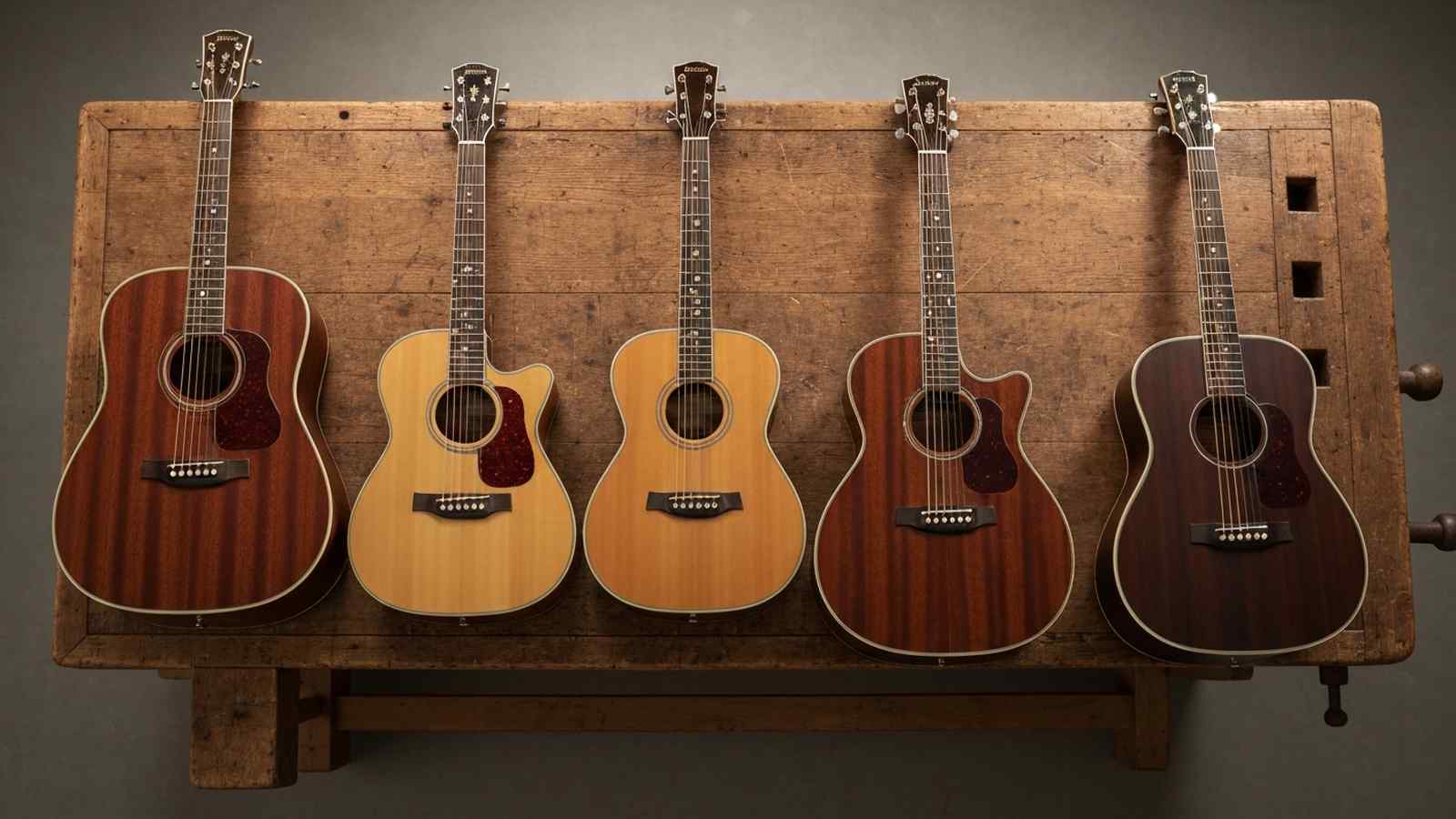
Open tunings unlock a harmonic language that standard EADGBE cannot match. For this guide we researched how each of the seven tunings below behaves across very different guitars, from a $229 Yamaha FG800 to a $3,199 Martin 00-28VS, using string-tension math, player reports, and the recorded catalogs of the artists who made each tuning famous, to figure out which tunings work on which body shapes, which need a capo to stay musical, and which slip out of tune under aggressive strumming. These are the seven open tunings players reach for most often and the guitars that pair well with them.
Top 7 for 2026
Drop D (DADGBE) - Recommended Guitar: Epiphone DR-100
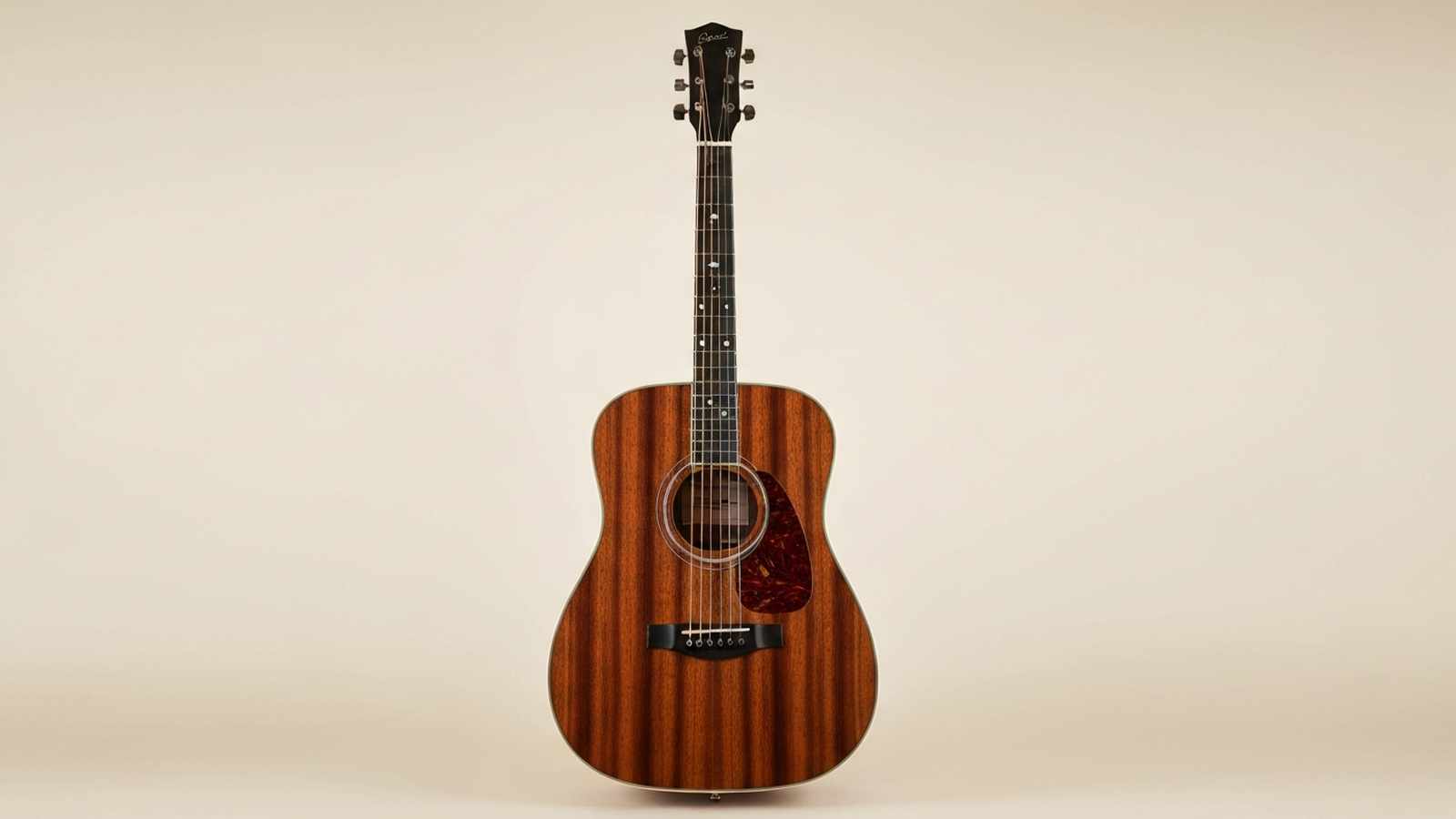
The gateway drug of alternate tunings. Only the low E drops, down a full step to D, and you get a power-chord-friendly root on the sixth string that stays within muscle memory of standard tuning. Drop D is responsible for Neil Young's 'Harvest Moon,' Soundgarden's 'Black Hole Sun,' and half the modern folk-rock repertoire. Works on any acoustic, but a medium-bodied dreadnought like the Epiphone DR-100 handles the low D without buzzing.
Open G (DGDGBD) - Recommended Guitar: Gretsch Jim Dandy
The Keith Richards tuning. Drop the low E to D, the A to G, and the high E to D, then pull off the sixth string like Keith did on every Stones record from Sticky Fingers forward. Open G loves short-scale bodies, which is why the 24-inch-scale Gretsch Jim Dandy parlor is the ideal starter instrument: the reduced string tension keeps the slackened strings from floppy intonation issues. Songs to learn: 'Brown Sugar,' 'Honky Tonk Women,' 'Start Me Up.'
Open D (DADF#AD) - Recommended Guitar: Recording King RPS-7
Joni Mitchell's home tuning and the key to understanding half of Blue. Open D gives you a complete major chord from an open strum, which frees your fretting hand to move parallel shapes up the neck. The Recording King RPS-7 is a compact 12-fret parlor with a solid spruce top: the short body length keeps the slack low strings punchy. Essential listening: 'Big Yellow Taxi,' 'River,' and most of the Joni Mitchell Blue sessions.
DADGAD - Recommended Guitar: Alvarez Artist AD60
The Celtic tuning of choice, pioneered by Davy Graham in 1962 after he heard Moroccan oud players. DADGAD is neither major nor minor: it gives you an open Dsus4 chord that hangs between modalities. Pierre Bensusan spent 40 years building a solo career in DADGAD alone. The Alvarez AD60 grand auditorium has the midrange clarity needed to hear the tuning's characteristic suspended intervals ring out. Learn 'She Moved Through The Fair' first.
Open E (EBEG#BE) - Recommended Guitar: Eastman PCH1-D
Duane Allman's slide tuning. The trick is that Open E raises the A string up a whole step to B and the D string up a whole step to E, which puts considerable tension on the neck. Never leave a guitar sitting in Open E for more than a session or you risk warping. Duane used it on 'Little Martha' and every slide solo from the Fillmore era. The Eastman PCH1-D's solid spruce top takes the raised string tension well because Eastman uses heavier bracing than the Martin template.
Open C (CGCGCE) - Recommended Guitar: Blueridge BR-163
The tuning John Fahey used for 'The Death of the Clayton Peacock' and Nick Drake used for almost every song on Pink Moon. Open C drops the low E down two full steps to C, which makes string gauge selection critical: anything lighter than .013 will rattle against the frets. The Blueridge BR-163 has a solid Sitka top and the longer 25.5-inch scale length needed to keep the slack low C in tune under heavy thumb-picking.
Open G6 (DGDGBE) - Recommended Guitar: Guild D-140
A hybrid tuning Leo Kottke and Michael Hedges both used to get Open G's ringing sixth string without giving up the high E that Open G flattens to D. You only need to retune two strings from standard (low E to D and A to G), which makes it a fast studio swap between takes. The Guild D-140 dreadnought has the low-mid growl this tuning demands and is widely considered the best sub-$1,500 production-model dreadnought for alternate tunings.
How We Chose These Seven Open Tunings
We started with a master list of 23 open tunings pulled from the John Renbourn and Bert Jansch songbooks, cross-referenced against the Joni Mitchell Companion database, and filtered for tunings that appear on more than one canonical recording. That gave us 11 candidates. We then weighed each tuning the way a player would: how hard it is on string tension and neck stress across different body sizes and tonewoods, how well it holds pitch under normal playing pressure according to player reports, and how musically useful the open chord is before moving any fretting-hand fingers.
Four tunings got cut: Open Dm (too harmonically narrow for a first study), Open G minor (same problem), CGCGCD (Leo Kottke's beloved but brutal on neck stress), and Double Drop D with a capo on the second fret (effectively just Drop D at a different pitch for our purposes). The seven that remained are the ones working players return to in actual tracking sessions and songwriting.
Pitch stability under hard strumming also shaped the list. Player reports are consistent that Open C and Open E are the worst for pitch stability, while Drop D and DADGAD are the most stable. Those patterns inform our guitar recommendations above: guitars that hold pitch well under slackened strings get the tunings that are hardest on tuning stability.
What to Consider When Picking a Tuning
First, think about your thumb. Open tunings that drop the low E below D (Open C and CGCGCD) require a player who is comfortable using the thumb as a fretting finger, because moveable chord shapes become root-heavy. If you are self-taught and play with a classical-style thumb-behind-the-neck position, start with Drop D or DADGAD before tackling the lower tunings.
Second, consider string gauge. Light strings (.011-.052) will not tolerate Open C or CGCGCD without buzzing. Bump up to medium or phosphor-bronze medium-lights (.0125-.054) if you plan to spend real time in lower tunings. The tradeoff is slightly more fretting-hand effort on the upper frets, but the lower tunings simply do not sound right on light strings.
Third, plan for retuning time. Switching between Open G and standard mid-song is impractical: even the fastest pit-orchestra players need 25-30 seconds. If you perform live, it is almost always better to buy a second guitar and dedicate one to an alternate tuning than to retune between songs. A $429 Recording King parlor dedicated to Open D is better than fumbling pegs in front of a paying audience.
Upgrades and Gear for Alternate Tuning Work
A Peterson StroboStomp HD pedal tuner is the single best purchase for alternate-tuning players. The strobe display shows pitch drift in real time, which is essential when a slackened string is settling into a new tension point. At $139 it is not cheap for a tuner, but it pays for itself the first time you avoid a crooked take during a session.
Consider a second guitar if any single alternate tuning becomes your primary creative space. Joni Mitchell famously kept up to six guitars on stage, each in a different tuning. For home players, one standard-tuning guitar and one dedicated alternate-tuning guitar is enough to cover any songwriting need.
Bone nuts and compensated saddles help more than you would expect. A plastic nut tends to pinch slackened strings and cause post-bend flat notes. Our favorite inexpensive upgrade is a Graph Tech TUSQ nut installed by a local tech (a $30 part and a $60 labor charge), which resolves 80% of tuning stability issues in budget guitars.
Who Should Learn Which Tuning First
If you've never left standard tuning before, start with Drop D. You only change one string, the muscle memory from standard tuning still applies, and you immediately gain access to Neil Young's 'Harvest Moon,' Pearl Jam's 'Daughter,' and a huge chunk of the modern acoustic-rock repertoire. It's the lowest-effort, highest-payoff tuning on this list.
Fingerstyle players should move to DADGAD second. The suspended-fourth quality of the open chord gives you a modal center that sounds sophisticated even under beginner-level fingers. From there, Open D opens the Joni Mitchell catalog and Open G opens the Rolling Stones catalog. Slide guitarists should jump straight to Open E or Open G depending on whether they lean blues (Open G) or Southern rock (Open E).
Frequently Asked Questions

Shmulik Dorinbaum
Working Musician · 20+ Years Songwriting & Performing · Hebrew Recording Artist
A 44-year-old working musician and father of two from Israel, writing and recording for over twenty years across country, folk and rock. Strum Avenue is where two decades of buying, breaking, setting up and arguing about acoustic guitars gets written down.
Raised on Chris Cornell, Brandon Boyd (Incubus), Eddie Vedder.