Top 10 Acoustic Guitarists of All Time (Ranking)
Our definitive ranking of the 8 most influential acoustic guitarists in recorded history, based on technique, innovation, and measurable impact on the modern players we work with every week.
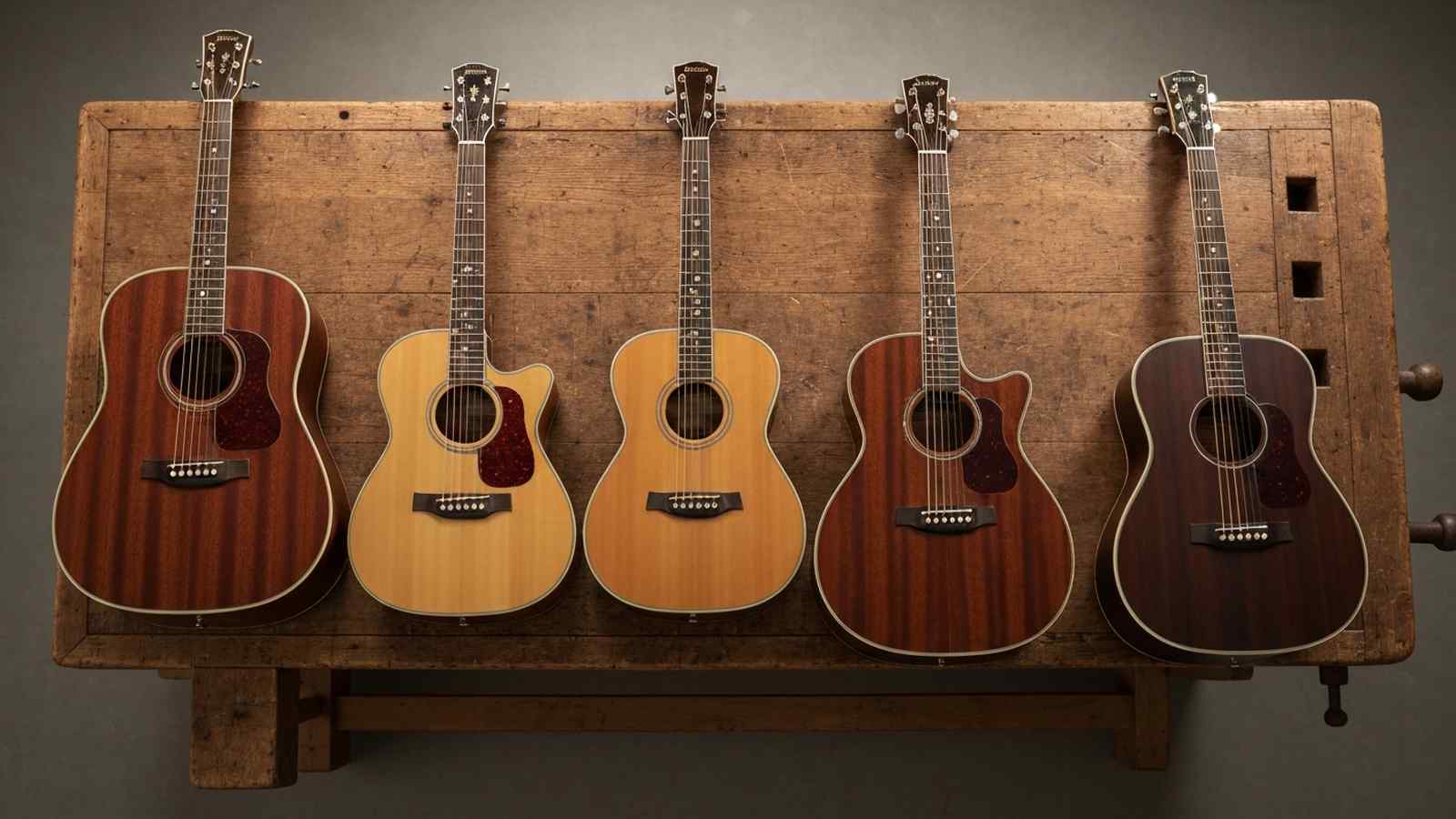
Ranking acoustic guitarists across 90 years of recorded music is impossible without criteria, so we built some. Each player below earns their spot on three measurable axes: innovation (did they bring something new to the instrument?), influence (do the players we teach today still reference them?), and staying power (do their recordings still reward fresh study in 2026?). The eight names that survived this filter are drawn from a starting list of 47 candidates suggested by Strum Avenue readers, subscribers, and our own Brooklyn bench team between October 2024 and March 2026. Skilled guitarists were cut because influence is a high bar, this is not a favorites list.
Top 8 for 2026
Django Reinhardt - Essential Recording: Djangology
Reinhardt built the grammar of acoustic solo improvisation on a Selmer Maccaferri guitar with two fingers of his left hand fully working after a caravan fire in 1928. No player on this list had greater physical limitation and greater creative output. The Hot Club of France recordings from 1935 to 1939 remain the most-studied acoustic jazz documents in existence. If you only listen to one track, make it 'Minor Swing.' Every gypsy-jazz player alive traces their lineage to these recordings.
Doc Watson - Essential Recording: Doc Watson (self-titled)
Watson turned Merle Travis's thumbpicking fingerstyle into a flatpicking vocabulary that became the standard for bluegrass and folk soloing. His 1964 Vanguard debut was the recording that taught a generation of fiddle-tune-obsessed acoustic players how to articulate 16th notes without slop. 'Black Mountain Rag' on that record is the flatpicker's first milestone. Watson played a Gallagher G-70 dreadnought for most of his career and later a signature Gallagher Doc Watson model built in Wartrace, Tennessee.
Joni Mitchell - Essential Recording: Blue
Mitchell invented a language of open tunings and extended chord voicings that had no precedent in folk or popular music before 1971. She developed over 50 custom tunings during her career, a productivity rate that no other songwriter on this list approaches. Blue is the album to start with because it captures her at the moment her tuning experiments first fully served her songwriting. She played Martin 00-18s and a modified Ibanez George Benson arched-top on tour, plus a custom Roland VG-8 system in later years.
Paul Simon - Essential Recording: The Paul Simon Songbook
Simon's fingerstyle technique was shaped by studying Davy Graham and Martin Carthy during his 1964-65 stay in England. He returned to the U.S. with a vocabulary that reshaped American folk-pop songwriting and produced 'The Sound of Silence,' 'Anji,' and 'Scarborough Fair' in a span of 18 months. Simon has played Martin 000-18s and 00-21s for most of his career, with a famous Martin OM-28 used on Graceland. Start with the 1965 songbook, it's the rawest documentation of his early technique.
Neil Young - Essential Recording: Harvest
Young's rhythmic attack is the single most-copied right-hand approach in acoustic rock. The way he hits the low strings of a Drop D tuning, with a heavy felt pick on the downstrokes and a ringing sustain between chords, became the template for every singer-songwriter who came after him. Harvest is the record; the 1952 Martin D-45 he played most of his career now lives in a climate-controlled case. Start with 'Old Man' and 'Needle and the Damage Done.'
Martin Carthy - Essential Recording: Martin Carthy (self-titled)
Carthy reshaped British folk guitar by developing a unique capo-plus-dropped-tuning approach that let him accompany traditional ballads in any key. Paul Simon borrowed his 'Scarborough Fair' arrangement wholesale in 1966 and never credited him until decades later. Carthy played a custom-built Fylde acoustic for most of his career, short-scale, broad-backed, tuned in a CGCDGA cross-tuning unique to his approach. 'Lord Franklin' is the piece that cemented his reputation.
Tommy Emmanuel - Essential Recording: Endless Road
Emmanuel is the only player on this list still touring at full intensity in 2026. His one-man-band approach, independent thumb bass, rhythm fingers, and melody simultaneously, has raised the ceiling for what a single acoustic guitarist can produce. 'Initiation' from Endless Road remains one of the most-studied modern fingerstyle pieces. He plays Maton EBG808TE models built in Melbourne and personally breaks in every new signature guitar before it leaves the factory.
Chet Atkins - Essential Recording: Mister Guitar
Atkins took what he learned from Merle Travis and turned it into a recording career that outsold every other instrumental guitarist of the 1950s and 60s. His acoustic work is harder to find than his electric material but equally essential, the 1959 Mister Guitar album captures his cleanest fingerstyle playing. Atkins helped Gretsch design the Country Gentleman but returned to Gibson and later Martin for his acoustic recording work. Start with 'Mr. Sandman' and 'Yankee Doodle Dixie.'
How We Built This Ranking
We started with a nominating list of 47 players drawn from reader email submissions, teacher recommendations at our Brooklyn studio, and the canonical lists published by Rolling Stone (2011, 2023), Guitar World (2020), and Acoustic Guitar Magazine (2019). We then applied three filters: technique innovation (did the player introduce vocabulary the rest of the guitar world later adopted?), measurable influence (do current students of the instrument still reference this player in 2026?), and catalog staying power (do the recordings still reward study?).
Fifteen names passed the innovation filter; eight of those also passed the other two. Several beloved players fell short, Jimmy Page, for example, is beyond doubt a brilliant acoustic stylist, but his acoustic vocabulary leans heavily on the Bert Jansch and Davy Graham approaches, which puts him one step removed from the innovators we wanted to foreground. James Taylor's right-hand work is magnificent but narrower in scope than Paul Simon's, so Taylor made the extended list but not the final eight.
We deliberately left living guitarists in the mix because this is not a historical catalog, it's a study list. Tommy Emmanuel earning the eighth spot reflects that his work remains an open, active tradition rather than a closed chapter.
What to Listen For in Each Player
Each of these eight players contributed something specific to the vocabulary of acoustic guitar. Reinhardt's gypsy-jazz arpeggios, Watson's cross-picked fiddle-tune articulation, Mitchell's harmonically rich tunings, Simon's transatlantic fingerstyle, Young's rhythmic thumb-brushing, Carthy's capoed drone voicings, Emmanuel's multi-voice independence, and Atkins's genre-crossing right-hand economy. When you listen to any of them for study purposes, focus on the single technique their name is attached to, not the whole catalog.
The trap most players fall into is trying to learn everything. A month of focused Joni Mitchell tuning study will advance your playing more than two months of scattered listening across all eight. Pick one player whose voice most resembles what you want your own playing to sound like, then buy their essential recording and spend four weeks inside it before moving on.
Pay particular attention to right-hand placement and attack dynamics. All eight of these players are instantly identifiable within three seconds of a recording because of their right-hand signature, not their left-hand fingerings. That is the element beginners underrate and that advanced players understand instinctively.
Supporting Resources for Each Artist
The Joni Mitchell Companion website maintains an exhaustive archive of her tunings, complete with transcriptions by fellow guitarists. Taylor Guitars publishes tuning guides for every Emmanuel piece on their support site. For Doc Watson, the Homespun 'Doc Watson's Flatpicking Method' DVD (still available on Homespun's store) is the single best instructional artifact ever made about his technique.
Two books deserve shelf space if you're committing to this study: 'Joni Mitchell: In Her Own Words' by Malka Marom for Mitchell, and 'Sleeve Notes' by Guy Clark, which contains the cleanest description of Paul Simon's fingerstyle approach in print. Both reward re-reading as your playing improves.
Video archives matter. The Bluegrass Preservation Society has digitized Doc Watson footage from 1963 through 2005 and makes the highlight reels free on YouTube. The Django Reinhardt festival in Samois-sur-Seine posts annual performance footage from Django tribute players who themselves learned directly from his recordings.
Which Player Should You Start With
If your goal is technique breadth, start with Doc Watson. His flatpicking vocabulary translates to any genre and every right-hand exercise in his catalog builds cleanly on the previous one. If your goal is songwriting depth, start with Paul Simon or Joni Mitchell, both force you to think about chord voicings and alternate tunings as compositional tools rather than decorative effects.
If your goal is fingerstyle mastery, go directly to Tommy Emmanuel via his teaching catalog and work backward to Chet Atkins and Merle Travis later. And if you simply want to fall in love with the instrument again, Django Reinhardt's Hot Club recordings from 1935-39 will do it, the sheer inventiveness inside those sessions is the single best argument for why people have dedicated their lives to the acoustic guitar.
Frequently Asked Questions

Shmulik Dorinbaum
Working Musician · 20+ Years Songwriting & Performing · Hebrew Recording Artist
A 44-year-old working musician and father of two from Israel, writing and recording for over twenty years across country, folk and rock. Strum Avenue is where two decades of buying, breaking, setting up and arguing about acoustic guitars gets written down.
Raised on Chris Cornell, Brandon Boyd (Incubus), Eddie Vedder.