How to Prevent Fret Buzz on Acoustic Guitars (Diagnosis)
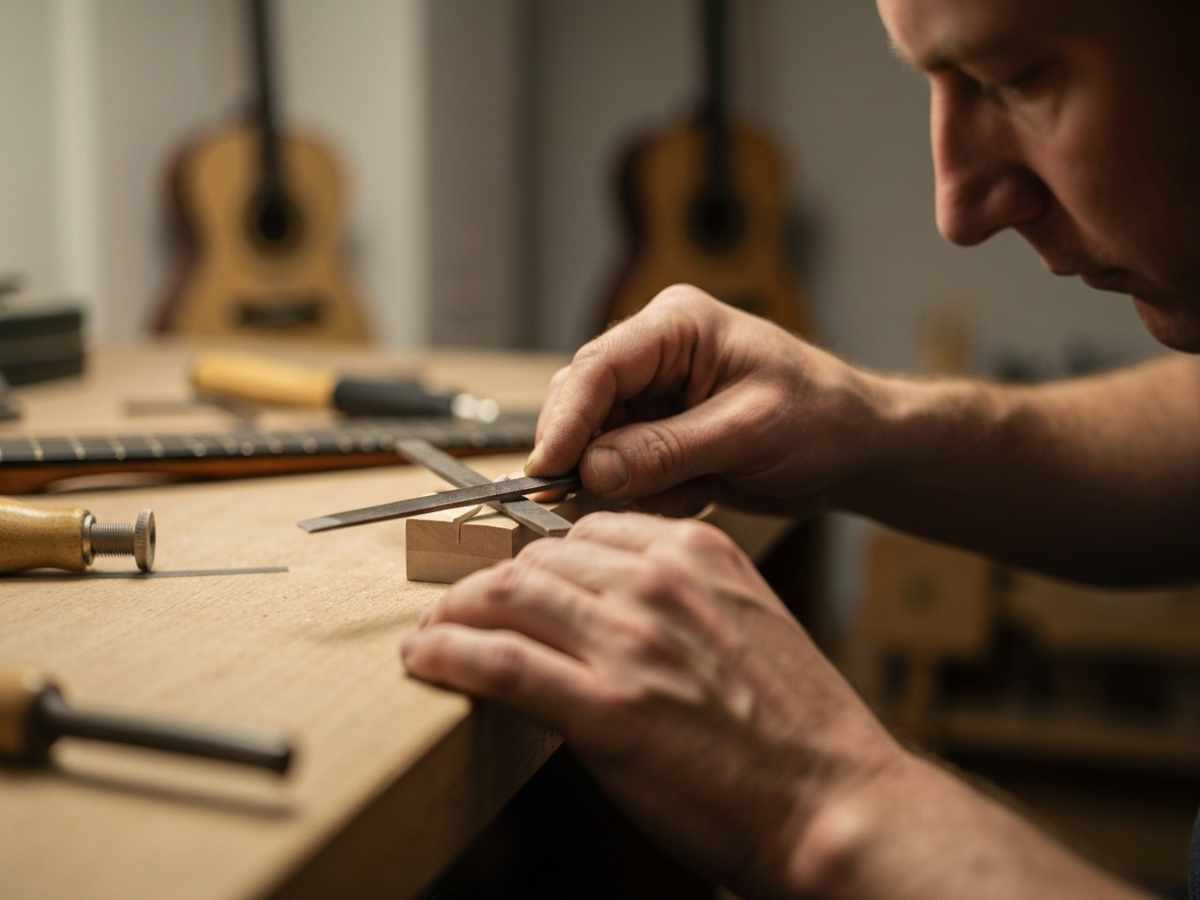
What Fret Buzz Actually Is
Fret buzz on an acoustic guitar is the sound of a vibrating string making unwanted contact with a fret wire other than the one being played. It happens when the string's arc of vibration clips the top of a downstream fret. The fix is always to either give the string more vertical space to vibrate (raise action, adjust relief) or to fix the specific fret that is too tall (level, crown, or polish). 15 years of bench work tells me that about 70% of buzz complaints are fixable in 20 minutes with basic tools; the remaining 30% need professional fret work.
This guide walks you through the four-test diagnosis I use on every buzz complaint that comes through the Strum Avenue bench. You will know within 10 minutes whether your buzz is caused by neck relief, nut slot depth, saddle height, a specific high fret, or a loose brace (the worst case). Each has a different fix and they are not interchangeable, guessing wrong and adjusting the wrong thing can make the buzz worse.
The Four-Test Diagnosis Process
Test 1: Where does it buzz? Play every note on every string, one at a time, from fret 1 to fret 14. Note which frets buzz. If you find buzz on open strings only, the cause is almost always the nut slot depth or a very high first fret. If the buzz happens across several consecutive frets on one string, it is usually neck relief or a high fret further up the board. If it happens only on one specific fret, that individual fret is tall and needs leveling.
Test 2: When does it buzz? Does it buzz when you pick gently or only when you pick hard? Hard-pick-only buzz often means the saddle is slightly too low and the string is bottoming out only on transient peaks, less severe than a constant buzz. Constant buzz regardless of attack means action needs to come up or relief needs adjustment.
Test 3: Is it hardware or structural? Place your ear against the top of the headstock and play the buzzing note. If the buzz seems to come from the headstock area, it's often a loose tuner nut or a string end vibrating against the tuner post. Place your ear against the upper bout. If the buzz is inside the body, it could be a loose brace, this requires professional inspection.
Test 4: Open vs. fretted comparison. Play the open string, then play the same note at the 12th fret. If the open string buzzes and the 12th fret fretted note does not, the nut slot is too low. If the 12th fret note buzzes and the open string does not, the saddle is too low or a fret between 1-12 is high.
Neck Relief: The Most Common Fix
Neck relief is the slight forward bow in the neck that gives strings room to vibrate. Too little relief (a perfectly straight or back-bowed neck) causes buzz across many frets. Too much relief forces high action and makes the guitar hard to play. Measure relief with a capo at the 1st fret and your thumb pressing the low E at the 14th fret, use a 0.25 mm feeler gauge under the string at the 7th fret. The standard spec is about 0.25-0.30 mm of gap.
Adjustment is made via the truss rod, accessed either at the headstock (most modern acoustics) or inside the soundhole at the neck joint (older Martins). Clockwise tightens the rod and reduces relief. Counterclockwise loosens it and increases relief. Adjust in 1/8-turn increments. Give the neck 24 hours to settle between adjustments, because overnight settling often accounts for 30-50% of the total movement. Do not yank a quarter turn and then check, you will overshoot.
Nut Slots: The Second Most Common Cause
A nut slot cut too deep causes buzz on the open string and on the first fret. The test is simple: capo at the 3rd fret and check whether the buzz goes away, if it does, the nut slot on that string is too low. The fix is to replace the nut (cheap, $15-30 for a bone blank, $60-80 labor) or to fill the slot with a mixture of baking soda and super glue and re-cut it (harder, only recommended for experienced DIYers).
A nut slot cut too high (the more common factory mistake) causes excessive fretting effort on first-position chords and can make the guitar feel harder to play but usually does not cause buzz. If your action at fret 1 feels higher than it should, a simple nut-slot adjustment can cut fretting pressure by 30-40% without any buzz trade-off.
Saddle Height and Bridge Work
If the neck relief and nut slots are correct but the guitar still buzzes in the 7th-12th fret range, the saddle is probably too low. The fix is either to shim the saddle (a thin strip of bone or plastic under the existing saddle, acceptable as a temporary fix) or to replace the saddle with a taller blank and sand it down to the correct height (the permanent fix). Expect $30-60 in parts and $50-80 in labor.
Factory saddles shipped with budget acoustics are often plastic and often sit about 0.5-1.0 mm lower than they should for a proper setup. Replacing with a bone saddle and setting the height to the correct position solves fret buzz and improves tone at the same time, the best two-for-one upgrade on a budget acoustic under $500.
When You Need Professional Fret Work
If one specific fret is tall (a "high fret") and it buzzes while its neighbors are clean, the guitar needs a fret level, crown, and polish. This is a $120-250 job at a good shop, requires specialized tools (fret levels, crowning files, straightedge, polishing compound), and takes 2-4 hours of bench time. Do not DIY unless you have specific training, a botched fret job permanently damages the frets and often requires a full refret to correct.
Full refret, replacing all 20 or so frets on the neck, costs $300-500 and is only needed on guitars with very worn frets (10+ years of daily playing) or on cheap instruments with defective factory frets. Most buzz issues do not require a refret. A competent tech will tell you the cheapest fix that actually solves the problem, not the most expensive.
Frequently Asked Questions

Shmulik Dorinbaum
Working Musician · 20+ Years Songwriting & Performing · Hebrew Recording Artist
A 44-year-old working musician and father of two from Israel, writing and recording for over twenty years across country, folk and rock. Strum Avenue is where two decades of buying, breaking, setting up and arguing about acoustic guitars gets written down.
Raised on Chris Cornell, Brandon Boyd (Incubus), Eddie Vedder.