How to Play Slide Guitar on an Acoustic (Beginner's Guide)
What Acoustic Slide Actually Requires
Acoustic slide guitar needs three things that standard playing does not: action raised to about 3.2mm at the 12th fret, an open tuning like Open D or Open G, and a slide of the right material and weight for your string gauge. That's the equipment side. The technique side requires left-hand muting that most players never learn for standard technique, and the ability to hit a target fret within 2mm without looking. The good news is that functional slide playing, enough to cover basic blues songs by Son House, Robert Johnson, or Derek Trucks-adjacent material, is achievable in four focused weeks.
This guide assumes you already play basic acoustic at an intermediate level (open chords, simple fingerpicking). I walk you through setting up a second guitar specifically for slide (highly recommended), choosing a slide, tuning to Open D, and the four-week progression I use with students who want to learn bottleneck blues without wrecking their regular playing.
Setting Up a Guitar for Slide
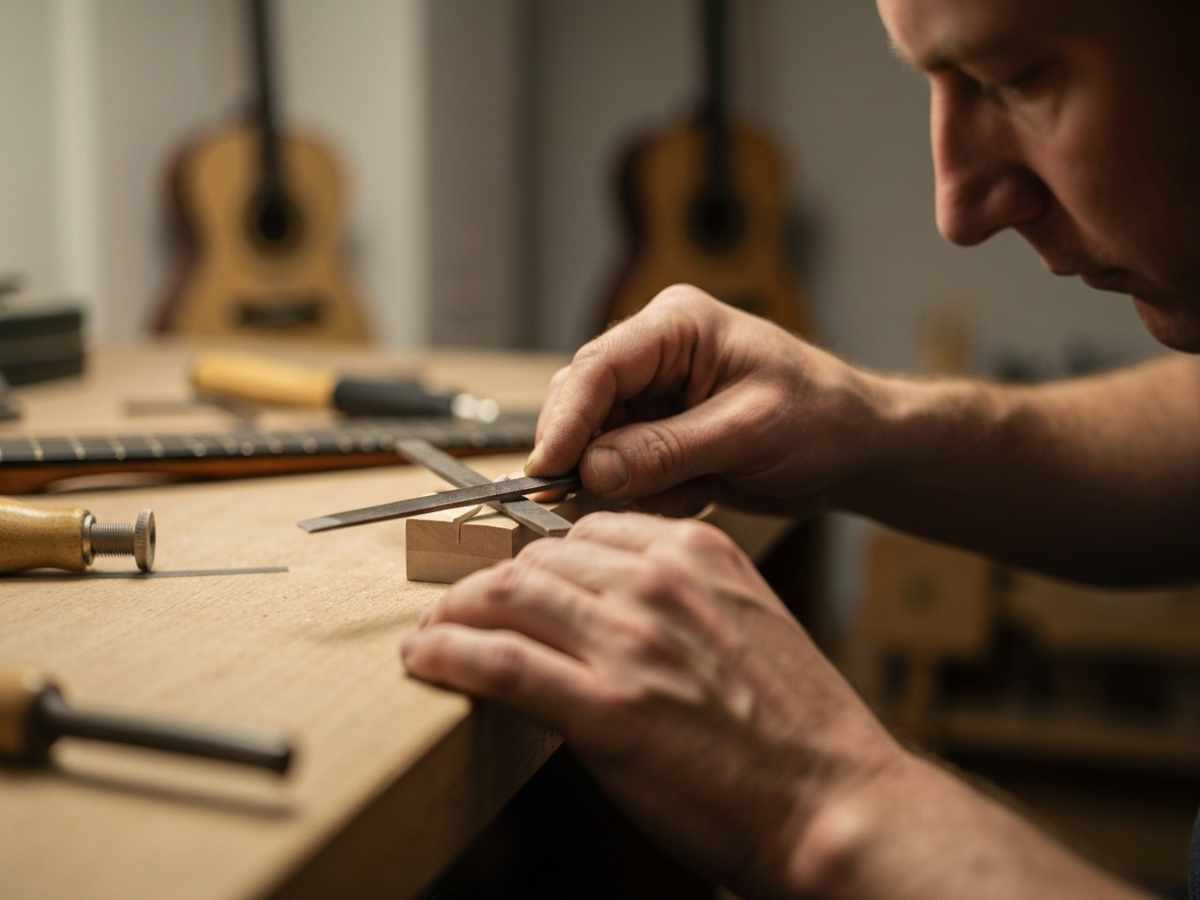
Slide guitar works best with action raised to about 3.0-3.5mm at the 12th fret on the low E side, roughly 0.6-1.0mm higher than a typical fingerstyle setup. Higher action prevents the slide from rattling against the frets during descending passages. If you try to play slide on a low-action guitar, you will fight buzz constantly and never get a clean tone. The fix is a raised saddle or a slide-specific nut extender called a nut riser, both available for $15-30.
My recommendation: keep your main acoustic at standard low action and buy a second inexpensive acoustic (used Yamaha F310 or Fender CD-60, $100-180 on the used market) specifically for slide. Set the second guitar up with Open D tuning, medium-heavy strings (.013-.056), and 3.2mm action. You will be far happier than trying to retune and adjust one guitar constantly.
Choosing a Slide: Glass, Brass, or Ceramic
Glass slides (Dunlop 210 Pyrex, Diamond Bottlenecks) are the traditional choice for acoustic. They sound warm, soft on the attack, and have moderate sustain. A standard Dunlop 210 glass slide runs $6-10 and fits most ring-finger sizes. Glass is what Son House, Muddy Waters, and Duane Allman used on acoustic, it is the default for blues slide.
Brass slides (Dunlop 224, Jim Dunlop heavy brass) are louder, brighter, and have longer sustain than glass. They are harder on your finger and your strings, and they cost $12-20. Brass is better for rock slide work and cutting through a loud band. Ceramic slides (Mudslide, Rock Slide) are a good middle ground, warmer than brass, louder than glass, heavier than both. Try a glass slide first. Most acoustic slide players settle on glass after trying all three.
Tuning to Open D (DADF#AD)
Open D tuning, D, A, D, F#, A, D from low to high, turns the open strings into a D major chord. This means a barre across any fret with the slide produces a full major chord of that fret's root note. The 12th fret is D (octave), the 7th is A, the 5th is G, the 3rd is F. This is why slide players favor open tunings: they eliminate the need to fret complex chord shapes while the slide is in use.
To get from standard to Open D from low to high: drop the low E to D (one whole step down), leave A alone, drop the D to... wait, leave the D alone, drop the G to F# (half step), leave the B... drop the B to A (whole step), drop the high E to D (whole step). Use a clip-on tuner to confirm each string. Open D and Open G (DGDGBD) are the two most common slide tunings. Start with Open D because the string tension changes are smaller.
Four-Week Practice Plan for Acoustic Slide
Week 1: Find the note. Practice playing a clean note on each string at the 12th fret, 7th fret, and 5th fret. The slide must sit directly over the fret wire, not behind it as you would for fingering. This single placement detail separates functional slide players from beginners who sound flat or sharp on every note. Drill this for 10 minutes daily.
Week 2: Muting. Your fretting hand's index and middle fingers should rest lightly on the strings behind the slide. This mutes unwanted open-string ringing and harmonic overtones. Without this muting, every slide movement creates a cloud of extra notes that make the playing sound sloppy. Practice muted scale runs on the fourth and fifth strings for 10 minutes daily.
Week 3: Vibrato. Slide vibrato is different from fingered vibrato, it comes from a horizontal wobble (1-3 mm each direction) around the target note, not a bend. Derek Trucks' vibrato is the model. Practice a single note at the 12th fret with a slow, even wobble for 2 minutes daily. This is the hardest week for most students.
Week 4: First song. Son House's "Death Letter Blues" in Open D is the classic first slide piece. Robert Johnson's "Come On in My Kitchen" also works. Both use basic 12th fret, 7th fret, and open-string patterns that a four-week student can realistically attempt.
Right-Hand Technique: Fingers, Not a Pick
Slide players almost always play with fingers or a thumbpick rather than a flatpick. The reason is that slide technique relies heavily on muting individual strings with the picking-hand palm and available fingers, and a flatpick makes this nearly impossible. Most acoustic slide players use a thumbpick (Fred Kelly Speed Pick or Dunlop 9020 are the standard choices) plus two or three fingers on the treble strings.
The right-hand palm should rest gently against the strings near the bridge, damping unwanted ringing. This is called palm muting and it is the counterpart to left-hand muting, together they clean up the sound. Without both, slide playing becomes a muddy wash of overtones. Watch a video of Derek Trucks' right hand on a ballad and you will see how much muting is happening at all times.
Frequently Asked Questions

Shmulik Dorinbaum
Working Musician · 20+ Years Songwriting & Performing · Hebrew Recording Artist
A 44-year-old working musician and father of two from Israel, writing and recording for over twenty years across country, folk and rock. Strum Avenue is where two decades of buying, breaking, setting up and arguing about acoustic guitars gets written down.
Raised on Chris Cornell, Brandon Boyd (Incubus), Eddie Vedder.