How to Play Acoustic Guitar Without Pain (Guide)
Why Acoustic Guitar Hurts (and Why It Shouldn't)
Acoustic guitar pain comes from four sources: excessive string action above 2.8mm at the 12th fret, improper left-hand thumb position, unsupported right-wrist posture, and insufficient warm-up before sessions longer than 20 minutes. Teachers and repair techs consistently trace the vast majority of student pain complaints back to one of these four causes, and the fix typically takes 10 to 14 days. This is not a toughness issue. Pain means something mechanical is wrong.
A properly set up acoustic, played with correct posture, should leave your fretting hand mildly tired after 45 minutes and fully recovered the next day. If you are still sore 24 hours later, something in this guide needs to change before you pick the guitar up again. Fingertip soreness during the first two weeks is different from joint or tendon pain: fingertip toughening is normal, joint pain is not.
Before Anything Else: Check Your Setup
A high action forces your fretting hand to work 30-50% harder than necessary, and that extra force accumulates into tendon strain over weeks. Measure your action at the 12th fret: low E should be 2.0-2.4mm, high E should be 1.6-1.8mm. Anything above 2.8mm on the low E side is a red flag on an acoustic and is the most common cause of thumb and wrist pain in beginners playing factory-shipped guitars.
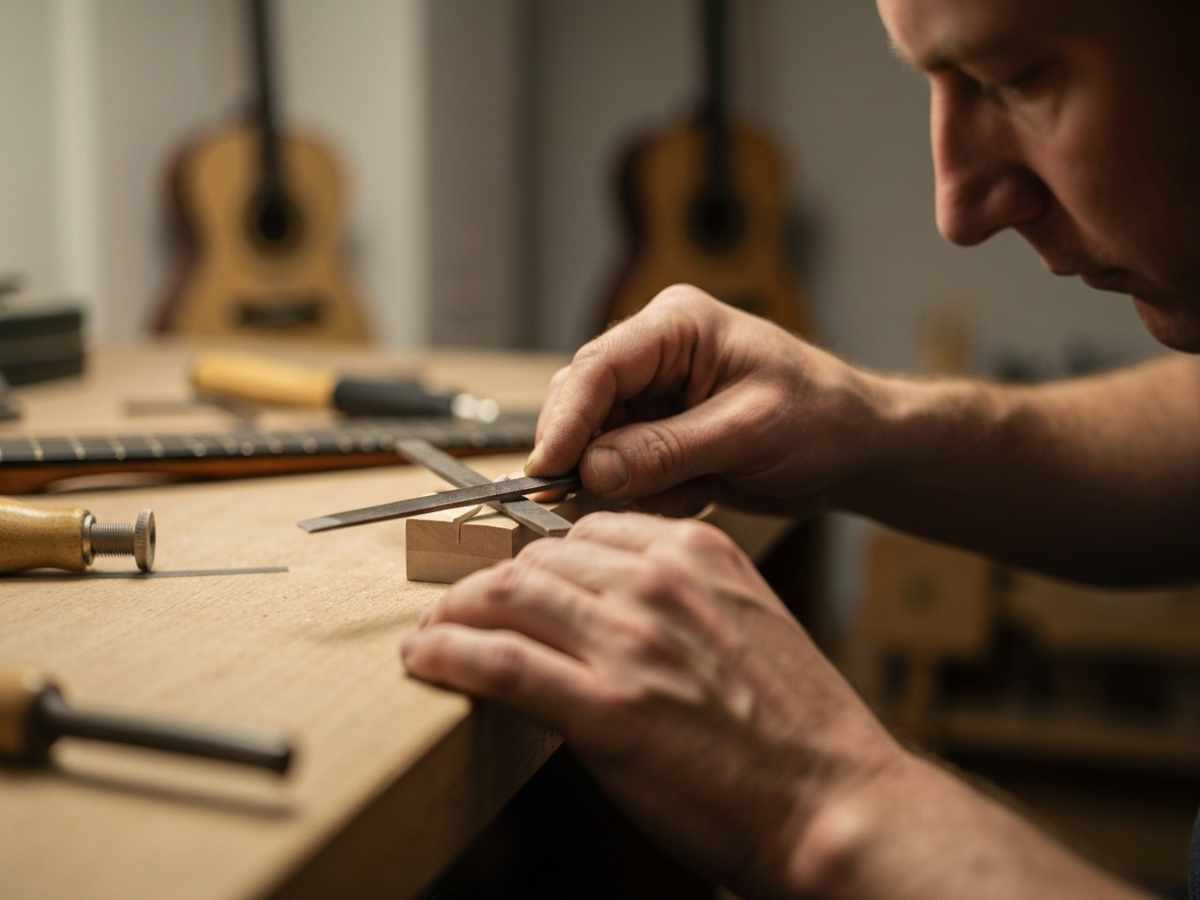
If the action is high, a proper setup by a qualified tech costs $50-80 and takes 45 minutes. They will adjust the truss rod, sand the saddle down in 0.3mm increments, and file the nut slots to proper depth. Skipping this step and trying to push through the pain is the single most damaging mistake a new student can make. Plenty of $200 guitars become genuinely pleasant to play after a $60 setup.
Posture and Sitting Position
Sit on a chair without armrests: a dining chair or piano bench works perfectly. Both feet flat on the floor. Rest the waist of the guitar on your right thigh if you are right-handed, classical position (guitar on left thigh with footstool) if you prefer that feel. Keep the headstock at roughly eye level when looking straight ahead. A slumped posture compresses your ribs and forces your right arm into an unnatural angle.
The right forearm should rest on the upper bout of the guitar at roughly 45 degrees. Your picking hand should hover over the soundhole, not press into the soundboard. If your right shoulder is lifted or your neck is craning forward to see the fretboard, the guitar is either too low on your lap or your chair is wrong. Raise the guitar. Students consistently underestimate how much pain a 2-inch adjustment in guitar height eliminates.
Left-Hand Position That Prevents Tendonitis
Your left thumb should sit roughly behind the 2nd fret when playing in open position, pad resting on the back of the neck, never wrapped over the top for chord work. Wrapping the thumb over the neck (Hendrix style) is fine for occasional bass notes but wrecks most beginner wrists if used as a default posture. The thumb's job is to provide counter-pressure, not to squeeze.
The fingers should curl so the tips contact the strings perpendicular, not flat-pad. You want to be pressing with the corner of your fingernail side, not the fleshy pad. This requires short nails on the fretting hand, a straight wrist (no bending beyond 15 degrees in either direction), and just enough pressure to make a clean note. Most beginners press three to five times harder than needed, which is the root of almost all fretting-hand fatigue.
The 5-Minute Warm-Up That Prevents Most Pain
Before any session longer than 10 minutes, run this sequence. One: wrist rolls, 10 each direction, both hands. Two: finger spreads, press all five fingertips together, then spread them wide, 10 reps. Three: a chromatic exercise on frets 1-4, strings 6-1, one finger per fret, played slowly at 60 BPM. Four: open chord changes between C, G, D, and Em for one minute. That's it.
Skipping warm-up is fine for 10-minute sessions but catches up with you hard at 30+ minutes. Think of it the way a runner thinks of stretching before a run: optional for a walk, necessary for a mile. The chromatic exercise specifically wakes up the small finger-flexor muscles in your forearm that do most of the fretting work.
Fingertip Pain vs. Joint Pain: Know the Difference
Fingertip soreness during the first 14 days of playing is normal and resolves itself. The dermis under the skin builds up a thicker layer of keratin in response to repeated string pressure. You cannot rush this process: no magic cream, no rubbing alcohol trick, no pre-callousing method beats two weeks of 15-20 minutes of daily play. By day 14 most students can play 30 minutes without fingertip discomfort.
Joint pain is different and should stop you immediately. Sharp pain in the knuckles, the base of the thumb, the wrist, or the forearm tendons is a mechanical problem, not a toughness problem. Common culprits: action too high, fingers pressing too hard, wrist bent too far, or grip too tight on the neck. Stop playing, identify which of the four it is, and fix the cause before your next session. Pushing through joint pain leads to tendonitis that can take 6-12 weeks to fully recover from.
Session Length and Recovery
Beginners: 15-20 minute sessions, twice a day, with 4+ hours between sessions. Intermediate players: 30-45 minutes with a 2-minute break every 15 minutes. Advanced or gigging players: up to 2 hours with 5-minute breaks every 25 minutes. The breaks are not optional, they are when your forearm flexors recover enough to keep working without micro-damage.
After every session, run your hand under warm water for 30 seconds, then spread your fingers wide five times. If your session was over an hour, add a cold compress for 10 minutes to the forearm. This sounds excessive until you've had tendonitis once, at which point you'll do it every time for the rest of your life.
Frequently Asked Questions

Shmulik Dorinbaum
Working Musician · 20+ Years Songwriting & Performing · Hebrew Recording Artist
A 44-year-old working musician and father of two from Israel, writing and recording for over twenty years across country, folk and rock. Strum Avenue is where two decades of buying, breaking, setting up and arguing about acoustic guitars gets written down.
Raised on Chris Cornell, Brandon Boyd (Incubus), Eddie Vedder.