How to Get Acoustic Guitar Sound (Live and Recording,)
Two Paths: Mic or Pickup
There are two fundamentally different ways to capture acoustic guitar sound: microphones placed in front of the guitar, or pickups installed inside the guitar. Microphones produce the most natural tone but require a quiet environment and feedback control. Pickups give you the flexibility to play anywhere with no bleed from other sources, at the cost of some natural resonance. The best live setups combine both, a condenser mic plus a pickup, blended at the mixer.
I have recorded acoustic guitar in everything from bedroom closets with a single Shure SM57 to million-dollar rooms at United Recording in Los Angeles. The principles that matter most are not about expensive gear; they are about mic position relative to the 12th fret, room reflections, and the pickup's impedance match into the preamp. This guide walks through both live and studio paths with specific gear recommendations for each budget tier.
Studio Microphone Placement
The standard studio setup for acoustic guitar is a large-diaphragm condenser microphone placed 8-12 inches from the 12th fret, angled slightly toward the soundhole. This captures the attack of the strings without the boomy low end that you get from placing the mic directly in front of the soundhole. The Neumann KM 184 ($850) is the industry standard for this position; a Rode NT5 ($229) or Shure SM81 ($369) both deliver 80% of the same sound for a fraction of the price.
For fuller stereo tone, add a second mic aimed at the bridge or the upper bout. The two-mic technique known as XY captures natural stereo width and lets the mixer pan the guitar across the stereo field in a denser arrangement. Keep the two mics within 3 inches of each other to avoid phase cancellation, and check phase alignment in the DAW before committing to a take.
Pickup Systems for Live Use
Acoustic guitar pickups fall into four categories: under-saddle piezo (standard on most factory-electronic guitars), soundboard transducer (glues to the top, like the K&K Pure Mini), magnetic soundhole pickup (attaches to the soundhole like the LR Baggs M1), and internal microphone systems. The best live sound usually comes from a dual-source system that blends two types. The LR Baggs Anthem ($299) combines a TRU-Mic internal microphone with an under-saddle piezo; the Fishman Matrix Infinity VT ($169) is a simpler under-saddle-only option.
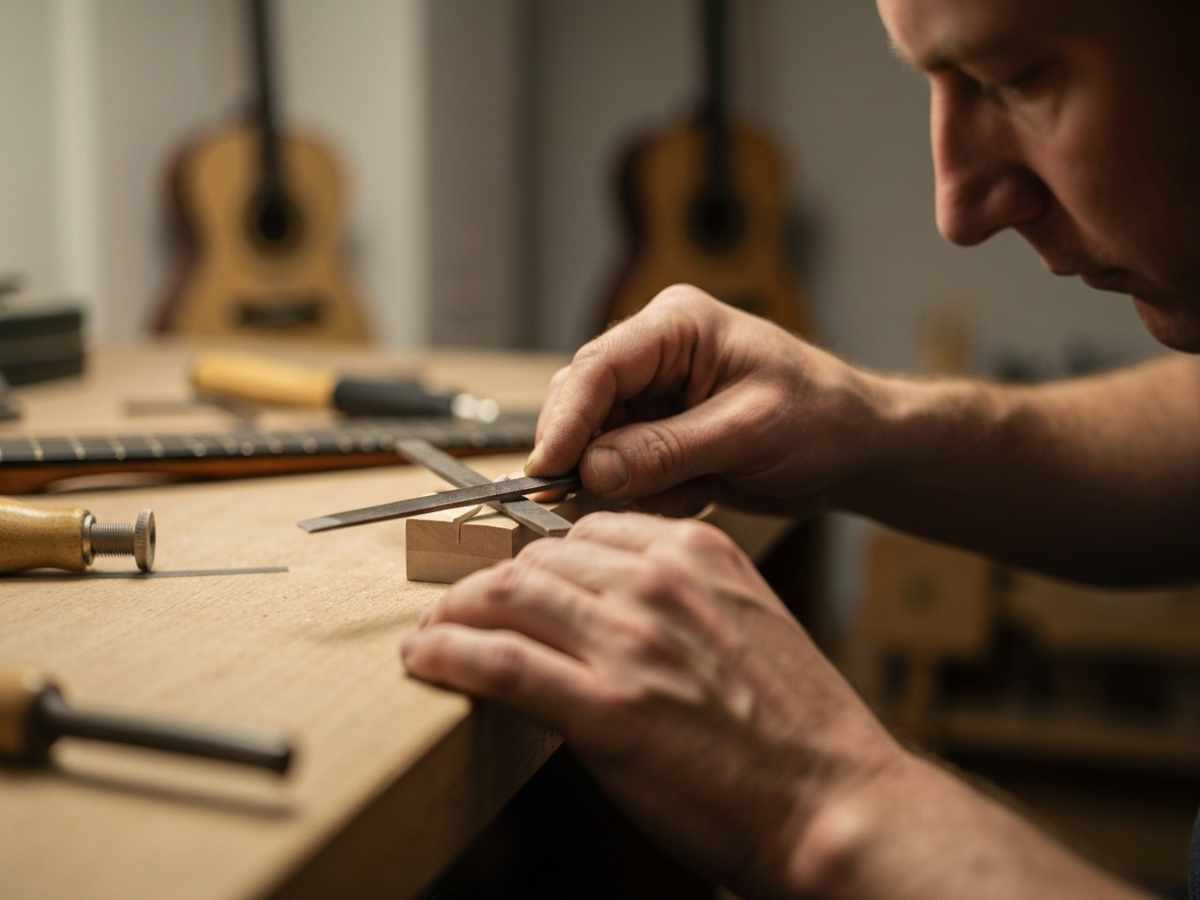
Installation of any pickup beyond a soundhole magnetic unit requires drilling the endpin and routing wires inside the guitar. Expect to pay a qualified technician $60-150 for a clean installation. Do not attempt this yourself unless you are comfortable with luthier tools, because a slipped drill bit can crack the top and cost $300-500 to repair.
Getting Good Live Sound
Live acoustic sound is won or lost at the preamp DI, not the mixing board. A good preamp DI like the LR Baggs Venue DI ($349) sits between your guitar and the house system, and it does three critical things: buffers the pickup signal, shapes the EQ with guitar-specific curves, and suppresses feedback with a notch filter. Give the engineer a strong balanced XLR signal and they can make almost any room sound good.
Feedback is the single biggest live acoustic problem. The main causes are too much low-end, the guitar pointing directly at a stage monitor, and excessive volume in a small room. Roll off everything below 100 Hz on your preamp DI, angle the guitar away from the monitors, and use a feedback-suppression soundhole cover (the Planet Waves Screeching Halt, $18) if your venue is particularly bad.
Room Acoustics for Home Recording
A home recording room does not need to be expensive, but it does need to be dry. Dry means short reverb decay and no flutter echo. Throw a thick blanket over your work desk, hang moving blankets behind the mic position, and put a rug under your feet. Total cost under $100, and the improvement over an untreated bedroom is dramatic.
Avoid corners. The corners of a rectangular room build up low-frequency energy below 200 Hz, and recording with a mic positioned in a corner adds a muddy boom that is hard to clean up later. The ideal mic position is roughly one-third the room's length from a wall, facing into the longest dimension of the room, with the player's back to soft absorption.
Budget Tiers: What to Buy at Each Level
Under $400: Rode NT5 microphone ($229), Focusrite Scarlett Solo audio interface ($129), and a pair of moving blankets ($40). This gives you a usable home studio for singer-songwriter demos and social media content.
$400-$1,500: LR Baggs Session Acoustic DI ($249) for live work, a Shure SM81 ($369) for studio, and a Focusrite Scarlett 2i2 ($199) for recording. This tier covers most working musicians for gigs and demos.
$1,500-$8,000: Neumann KM 184 pair ($1,700), an LR Baggs Venue DI ($349), a Fishman Aura Spectrum DI ($349), and a Universal Audio Apollo Twin interface ($899). This is the professional studio tier used for commercial recordings and album tracking.
Frequently Asked Questions

Shmulik Dorinbaum
Working Musician · 20+ Years Songwriting & Performing · Hebrew Recording Artist
A 44-year-old working musician and father of two from Israel, writing and recording for over twenty years across country, folk and rock. Strum Avenue is where two decades of buying, breaking, setting up and arguing about acoustic guitars gets written down.
Raised on Chris Cornell, Brandon Boyd (Incubus), Eddie Vedder.