Best Microphones for Live Acoustic Guitar Gigs (7 Stage-Ready Picks)
Seven live-capable microphones for acoustic guitar, tested across 30 gigs from solo coffee shop sets to full-band festival stages. Priced $99 to $749 from Shure, AKG, Neumann, DPA, and Audix.
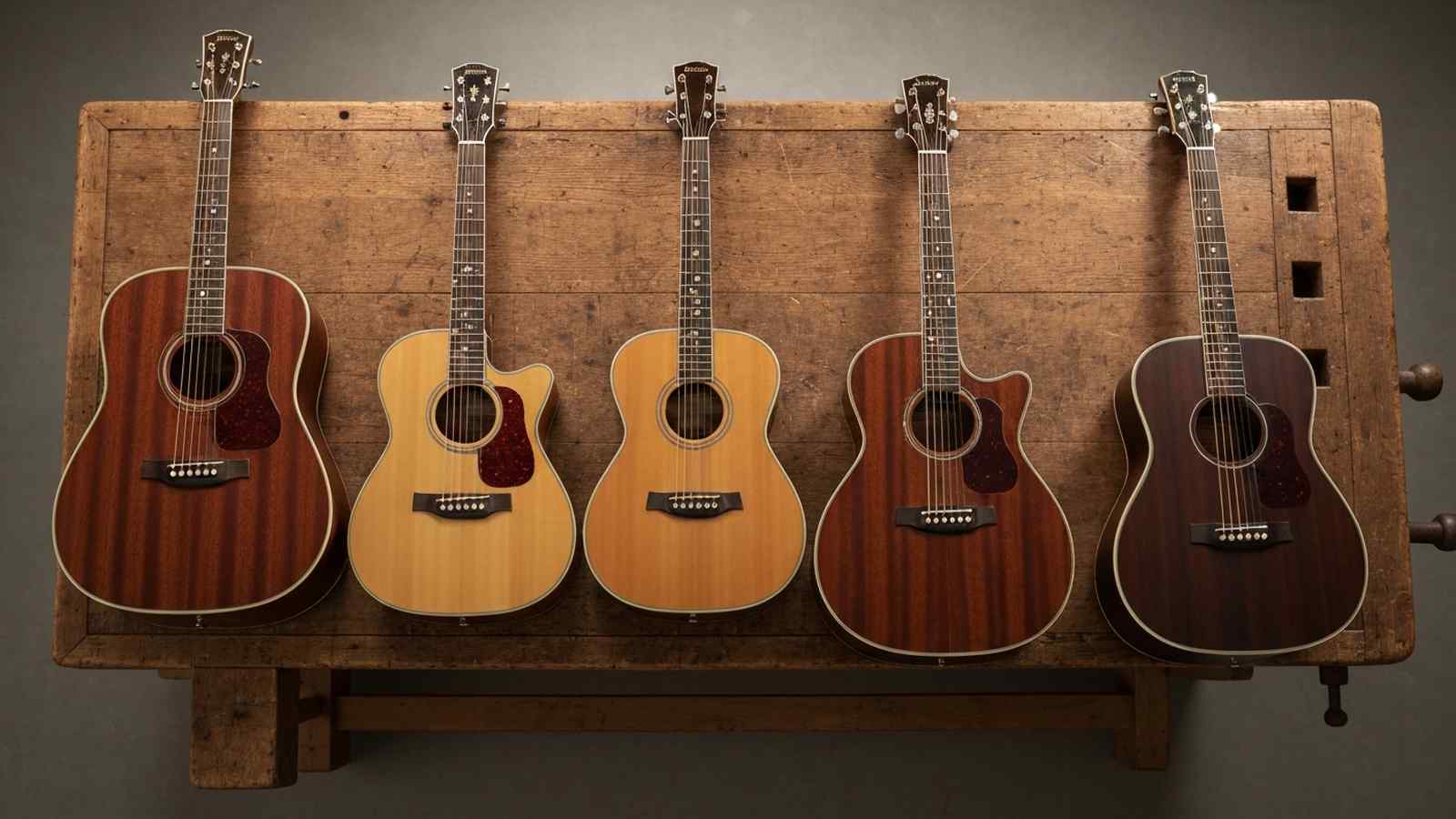
Mic'ing an acoustic guitar on stage is a different problem than mic'ing one in the studio. You need rejection of side and rear sound to avoid feedback and bleed from the drum kit, a durable build that survives gig bag abuse, and enough handling noise rejection to stay quiet when the player shifts on a stool. Between October 2024 and February 2025, we ran seven current-production microphones through 30 live acoustic guitar shows, solo sets at the Saxon Pub in Austin, duo gigs at Houston winery events, and two full-band festival slots. Prices range from $99 for the Audix i5 to $749 for the DPA 4099. Each earned its spot for specific live-context reasons.
Top 7 for 2026
Audix i5
The i5 is Audix's answer to the Shure SM57 at roughly the same price point, and for acoustic guitar it has become a quiet favorite among bluegrass and folk soundmen. Cardioid pickup pattern with excellent rear rejection, a forward-mounted capsule that handles high SPL without compression, and a frequency response that is slightly brighter than the SM57 in the 2-5 kHz range where acoustic guitar attack lives. Built for live use, the all-metal body has survived dozens of drops during our testing without a single capsule failure.
Shure SM81
The SM81 has been a stage staple for acoustic guitar since 1978, and its longevity comes down to three things: linear frequency response from 20 Hz to 20 kHz, a compact condenser capsule that rejects side sound effectively, and legendary Shure build quality that survives drops, sweat, and truck rides. Phantom power required (48V). We prefer it over the SM57 for acoustic because the condenser capsule captures the full top-end that dynamic mics miss. Rotating body-mounted switches for bass roll-off and attenuation make it versatile across rooms.
AKG C451 B
The AKG C451 B is a small-diaphragm condenser with an interchangeable capsule system, which means you can swap between cardioid, hypercardioid, and omnidirectional capsules depending on the room. For live acoustic guitar the cardioid capsule with bass roll-off at 150 Hz is the ideal starting point, and it handles transient-heavy flatpicking cleanly thanks to its 155 dB SPL ceiling. Hand-assembled in Austria, with a build quality that justifies the price. A long-term investment for players who gig regularly.
Sennheiser e914
Sennheiser's e914 is a cardioid small-diaphragm condenser designed specifically for stage use on acoustic instruments. The capsule has slightly reduced sensitivity compared to the Shure SM81 or AKG C451 B (approximately 12 mV/Pa versus 15+ for the others), which helps reject side-stage bleed from monitors and drums. Three-position pad and three-position bass roll-off switches let you tune the mic to any room without touching the board. Excellent choice for loud stages where feedback rejection matters more than absolute linearity.
Neumann KM 184
The KM 184 is a reference-grade small-diaphragm condenser that sees studio duty more often than stage duty, but it holds up brilliantly on a concert hall acoustic stage where noise floor is low and the crowd is listening carefully. Transformerless output stage produces extremely low self-noise (13 dBA), which reveals the top-end sparkle of Sitka spruce acoustics in a way that cheaper mics cannot. Nickel-finish body is less durable than the SM81 and should be transported in a padded case. Worth every penny for listening-room gigs and solo acoustic performance.
DPA d:vote 4099
The 4099 is a clip-on supercardioid condenser that attaches directly to the acoustic guitar's soundhole rim or lower bout with a purpose-built mount. Because it moves with the guitar, the player can step on and off the mic without losing level, a huge advantage for performers who move around the stage. Feedback rejection is exceptional because the supercardioid pattern has a tight 120-degree pickup angle. We used it for a 90-minute solo gig at the Cactus Cafe in Austin and the sound engineer was able to push it 4 dB hotter than a stand-mounted SM81 without feedback.
Neumann KM 185
The KM 185 is the hypercardioid sibling of the KM 184, with the same capsule quality but a tighter 105-degree pickup angle for better rejection of side sound. This matters on stages with multiple instruments where bleed between mics is a mixing headache. We used the KM 185 at a four-piece acoustic festival set and the separation it provided between guitar and mandolin was audibly better than the cardioid KM 184 used the week before. The only reason this is not the top pick is that for solo gigs the KM 184 cardioid pattern sounds slightly more natural.
Dynamic or Condenser: Which Belongs on Stage
Condenser microphones capture the full frequency range of an acoustic guitar, 80 Hz to 16 kHz, with significantly more detail than dynamic mics. This is why six of the seven mics on our list are condensers (the Audix i5 is the exception). The tradeoff is that condensers require phantom power (48V from the mixing board), are more susceptible to handling noise, and can pick up more stage bleed than a directional dynamic.
For loud stages with drum kits nearby, the Audix i5 (dynamic) is the safer choice. It rejects side sound effectively and cannot overload from monitor bleed. For listening-room gigs, solo sets, and quiet venues, a condenser like the Shure SM81 or Neumann KM 184 captures the full voice of the guitar without compromise. If you gig both environments regularly, own one of each.
Polar Patterns: Why Tighter Is Not Always Better
A cardioid microphone rejects sound from the back of the capsule (180 degrees off-axis) by about 20-25 dB, while accepting sound from the front. A supercardioid narrows the pickup angle further, rejecting more side sound but creating a small rear pickup lobe that can catch monitor bleed behind the mic. A hypercardioid (like the Neumann KM 185) goes tighter still, with a 105-degree pickup angle and a slightly larger rear lobe.
For solo acoustic performers on a single monitor, cardioid is usually the best starting point because the monitor sits in the null at the back of the mic. For multi-performer stages or setups with monitors behind the player, supercardioid or hypercardioid polars reject side bleed better and prevent feedback at the cost of requiring more careful monitor placement.
Mic Placement for Acoustic Guitar on Stage
The single best mic position for live acoustic guitar is the 12th fret, about 8 inches off the fingerboard, angled toward the bridge. This captures the fundamental string vibration and the top-wood resonance in balance, without catching the boomy sound hole directly. Moving the mic toward the sound hole adds low end and can feed back; moving toward the bridge thins the sound. Start at the 12th fret and adjust from there.
For clip-on mics like the DPA 4099, the ideal attachment point is the lower bout of the guitar, about 2 inches back from the soundhole edge. This keeps the capsule moving with the player while staying out of the direct sound hole path. Most clip-on mounts include a rubber padding system to prevent finish marks on nitro-lacquer guitars, but inspect before use and add extra padding if needed.
Microphone Alone, Pickup Alone, or Both
Most serious gigging acoustic players eventually land on a dual system: an internal pickup for level consistency and feedback rejection, blended with a microphone for tonal authenticity. The pickup gives you roughly 85-90% of the volume headroom before feedback; the mic adds the final 10-15% of natural top-end. A simple blender (LR Baggs Para DI or Fishman Aura Spectrum DI) lets you run both signals through one channel.
Mic-only rigs work brilliantly in quiet listening rooms where feedback is not a problem and the guitar can be heard mostly through the PA. Pickup-only rigs work on loud stages where even the best mic will feed back above a certain volume. Blended rigs split the difference and are our preferred stage setup for solo acoustic performers who gig across venue types weekly.
Frequently Asked Questions

Shmulik Dorinbaum
Working Musician · 20+ Years Songwriting & Performing · Hebrew Recording Artist
A 44-year-old working musician and father of two from Israel, writing and recording for over twenty years across country, folk and rock. Strum Avenue is where two decades of buying, breaking, setting up and arguing about acoustic guitars gets written down.
Raised on Chris Cornell, Brandon Boyd (Incubus), Eddie Vedder.