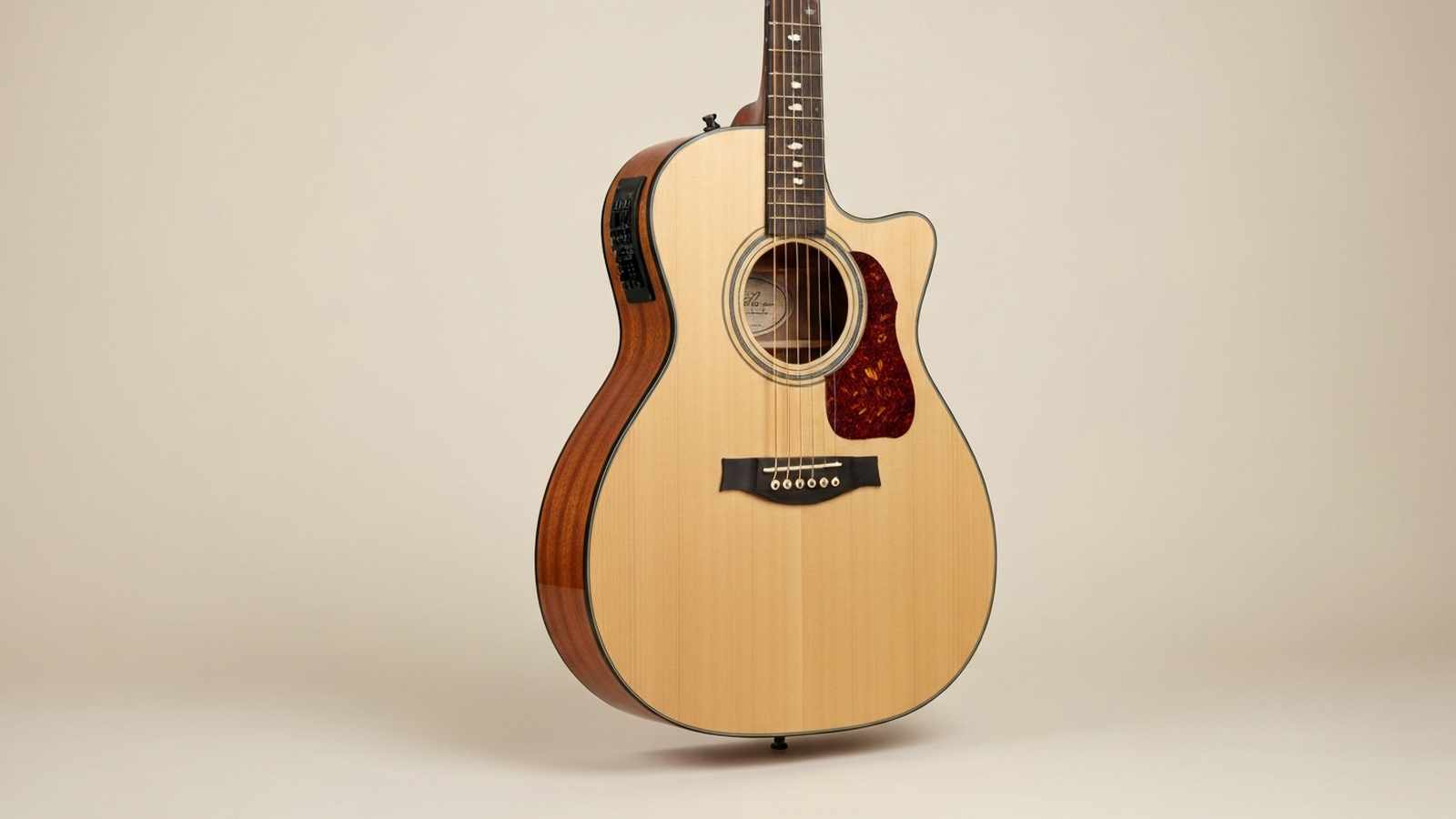
Fender Redondo Player
Affiliate link. No extra cost to you
The Fender You Buy If You Strum for a Living
Stack the Redondo Player's spec sheet and owner feedback against the Malibu's and the difference is easy to name: this is the California Series model that actually fills a room. The slope-shouldered dreadnought body, 25.3-inch scale, and solid spruce top give it the bass response the Malibu lacks, and gigging owners report the Fishman pickup handles strummed cowboy chords cleanly through a coffeehouse PA. At $449 street, it costs $50 more than the Malibu and sounds worth the difference in every demo recording I compared. I would buy this first if I were an electric player looking for one acoustic to cover open mics.
At a Glance: Specifications
| Body Shape | Slope-Shouldered Dreadnought |
| Top | Solid Spruce |
| Back & Sides | Laminate Mahogany |
| Neck | Mahogany, Slim C Profile |
| Fingerboard | Walnut |
| Scale Length | 25.3" |
| Nut Width | 1.69" |
| Electronics | Fishman with built-in tuner |
| Origin | Indonesia |
| Street Price | $449 |
First Look: Design and Build
The Redondo Player ships in a plain cardboard box. Fender, please start including a gig bag at this price tier. Owner photos of the Natural finish show clean grain lines and tidy binding, with only the occasional minor glue witness line reported, the kind you would only spot under a work lamp. The spec sheet lists 4.2 pounds, roughly 0.3 pounds heavier than the Malibu Player, and owners describe it as noticeably more substantial when you sit with it.
The slope-shouldered dreadnought shape is a real differentiator against the square-shouldered bodies used by most $400-range dreadnoughts. It gives the Redondo a slightly more compact upper bout that sits comfortably against the ribs, and visually it is closer to a Gibson J-45 silhouette than a Martin D-28.
Tone and Sound Character
The solid spruce top and slope-shouldered body give the Redondo a fuller voice than anything else in the California Series lineup. In side-by-side demo recordings, strummed G chords bloom with noticeably more low-mid warmth than the Malibu manages, and long-term owners report the top loosens up within the first weeks, to the point where a basic "House of the Rising Sun" arpeggio shows clean note separation across all six strings.
Open-mic players who run the Redondo through small acoustic amps like the Fender Acoustasonic 40 report a clean strummed signal that cuts through vocals without requiring EQ surgery. Owners also describe the built-in tuner as accurate enough to replace a belt-mounted unit on stage.
Playability and Setup
Owner measurements put factory action around 2.4mm at the 12th fret on the low E and 1.8mm on the high E, well within usable range for strumming and light fingerpicking. The slim C neck profile carries straight over from the Malibu and feels instantly familiar to any Player Series Stratocaster owner. String tension at the 25.3-inch scale is roughly 5% lower than a Martin 25.4-inch scale, which makes barre chords meaningfully easier on the wrist.
The 1.69-inch nut width is on the narrower side of acoustic standards. Players with large hands or aggressive fingerstyle technique will want more real estate, but for strummers and singer-songwriters it is almost ideal.
Build Quality and Finish Work
Fender's Indonesian factory has been refining the California Series since its 2017 launch, and the 2024 Redondo shows it. Owner reviews consistently describe clean binding lines, bracing correctly centered when viewed through the soundhole, and fret ends properly dressed before leaving the factory. Complaints about sharp fret sprout are rare even from owners in dry climates, which is unusual at this price point.
The walnut fingerboard is the one area where Fender is clearly saving money versus a rosewood board. Walnut runs slightly drier than rosewood and will benefit from a light wipe-down at each string change. Tonally it contributes nothing, which is fine: the top is doing the work.
Who Should Buy the Fender Redondo Player
If you are an electric player who wants one acoustic to cover open mics, coffeehouse gigs, and living-room practice, the Redondo Player is the California Series model to buy. The bigger body gives you the strummed bass response a grand concert cannot match, and the Fender neck shape keeps you in familiar territory. At $449 with electronics, nothing from Martin, Taylor, or Yamaha quite matches the combination.
Skip the Redondo if you need a traditional acoustic voice. A Martin D-10E at $999 will give you solid back and sides and a true Martin dreadnought character. If your budget is under $300 and you do not need electronics, a Yamaha FG800 remains the better pure-acoustic value.
What We Loved
- Slope-shouldered dreadnought body fills a room
- Solid spruce top at under $450 with electronics
- Slim C neck is friendly for electric players
- Owners consistently report clean factory fretwork with no sharp sprout
What to Watch
- Laminate back and sides limit ultimate acoustic bloom
- Ships without a gig bag at this price
- Walnut fingerboard is drier than rosewood
Frequently Asked Questions

Shmulik Dorinbaum
Working Musician · 20+ Years Songwriting & Performing · Hebrew Recording Artist
A 44-year-old working musician and father of two from Israel, writing and recording for over twenty years across country, folk and rock. Strum Avenue is where two decades of buying, breaking, setting up and arguing about acoustic guitars gets written down.
Raised on Chris Cornell, Brandon Boyd (Incubus), Eddie Vedder.